A Vigorous Lucidity: An Autobiographical Note on Book Editing and Design


            I recently found my high school textbook of Hamlet. A number of things about that edition surprised me, the first being that it was an interlinear edition, suggesting that we could not read Shakespeare without a trot or pony. I remembered such editions from my Latin classes, where of course they were forbidden, scorned as crutches, and used only surreptitiously outside of school. The second thing that caught my attention was that the fore-edge of my Hamlet was crudely marked in black ink with the school motto, as was the inside endpaper of the front cover: Tolle lege. Since magic markers did not exist in the early fifties I assume I’d used India ink, perhaps the stopper from the bottle, an ink our mothers used to identify our childhood underwear and clothing before sending us off to camp or, in my case, away to a military boarding school. (During the Second World War, I was known as “the little soldier,” as well as “the little man,” and all of our family of three were in uniform for the duration, my father a naval officer, my mother in the Red Cross, and myself in an itchy woolen miniature of West Point gray, impossible in the Southern California heat.) That same India ink we also used in gang initiations, for tattoos. Thirdly, across the free endpaper of my Hamlet sprawls the scrawl of my signature, blatantly less interested in legibility than in securing some adolescent dream of singularity, as the tattoos were supposed to have done at a slightly earlier period.

            My high school, St. Augustine’s, was run by Augustinian priests who prided themselves on being one of the original teaching orders. It was an all boys’ school, the only one in a county boasting eight Catholic girls’ schools, where the nuns lectured the girls that they should only date Catholic boys. We used to taunt the most pious boys by wisecracking that, after all, Martin Luther had been an Augustinian, a joke not regarded as witty by the priests. The school motto, as I mentioned, was Tolle lege, Take it and read. The origin of this phrase marks one of the most remarkable moments in Augustine’s Confessions, his conversion in the garden in Milan. Sitting under a fig tree Augustine hears a child’s voice chanting as if in the singsong of some children’s game, Tolle lege. Tolle lege. He has been in an agony of desire, torn between two warring wills, those of his higher and lower natures. The book he has at hand in the garden is the Epistles of St. Paul. He seizes it and opens it at random, a sortilege of longing and agony. The book opens to Romans 13:13, 14: “Not in reveling and in drunkenness, not in lust and in wantonness, not in quarrels and in rivalries. Rather, arm yourselves with the Lord Jesus Christ; spend no more thought on nature and nature’s appetites.” Augustine continues, “I had no wish to read more and no need to do so. For in an instant, as I came to the end of the sentence, it was as though a light of confidence flooded into my heart and all the darkness of doubt was dispelled.” (Bk 8:12.) Sortilege, which means divination by using a book, was also practiced in the Roman Empire by consulting the Aeneid.

            Augustine’s conversion was from the flesh to the spirit. The state of his agonized longing is structurally characteristic of adolescence. The state of my own adolescent longings was in the opposite directions. Such pieties and theological longings as I may have possessed disappeared (agonizingly, of course) when, at age nineteen, I began my first long term sexual intimacy. Nineteen was the age at which my namesake resolved, upon reading Cicero’s Hortensius, that philosophy would be his path. The antithesis of Romans 13 was my philosophical path: sex and drugs and jazz (rock-and-roll I fellow-traveled for the sex and drugs). So it was two summers after the summer of love, 1969, that I first met Jack Stauffacher. This brings me, less circuitously than might appear, to continuing my praise of Jack’s Greenwood Press, directly now rather than obliquely.
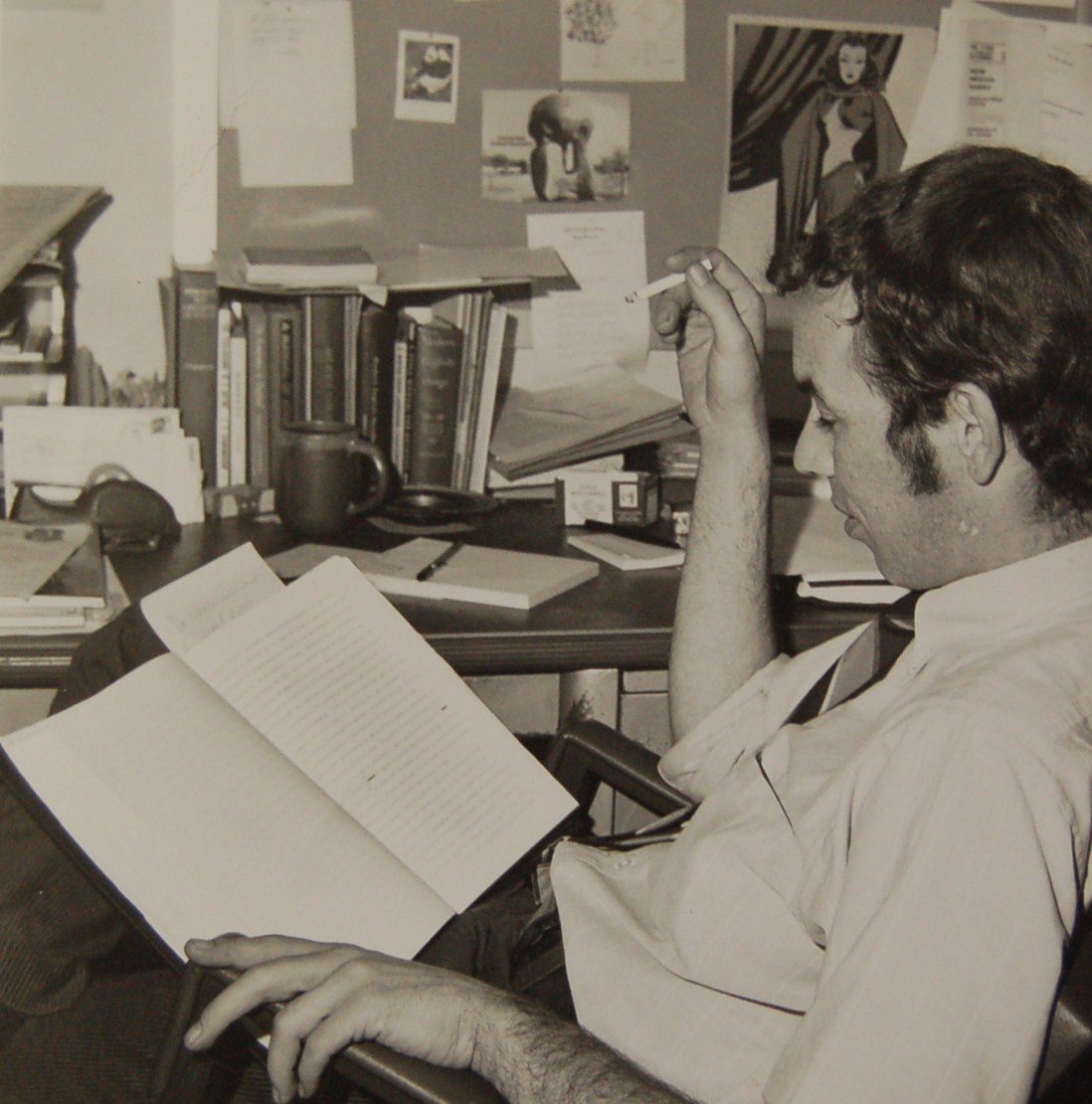
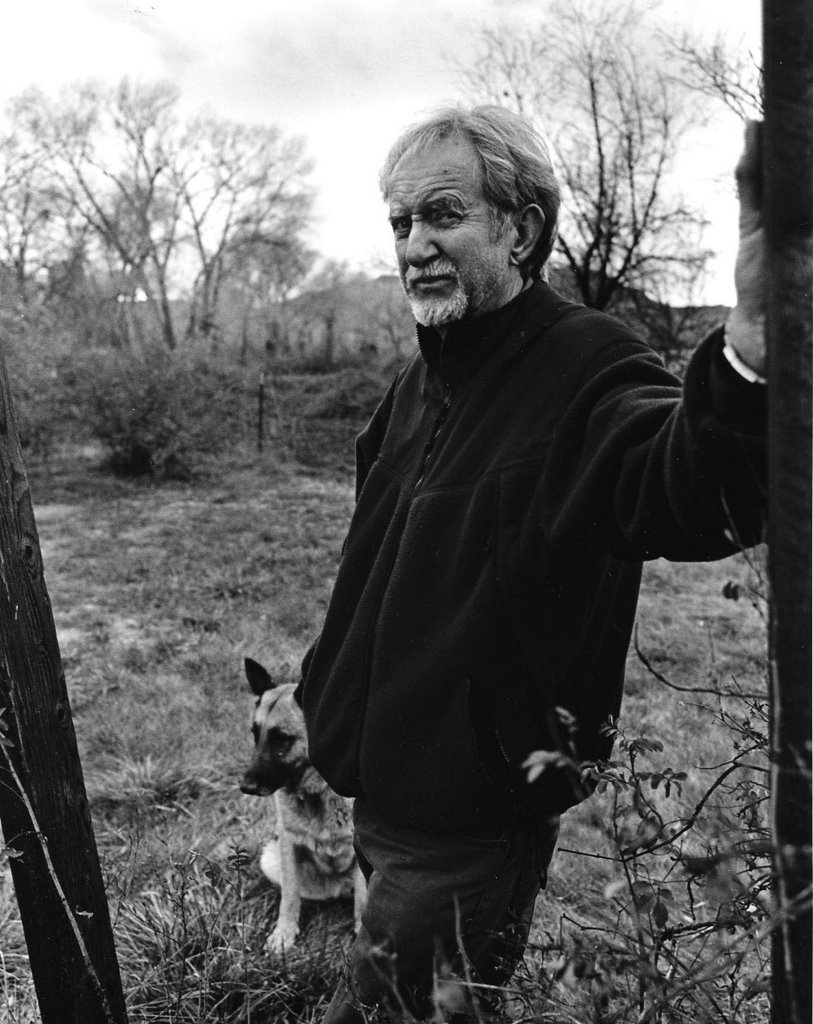
Gus Blaisdell editor at UNM Press

            Unbeknownst to me, my eventually meeting Jack began three years earlier, when I was an editor at the University of New Mexico Press working on books and also on the New Mexico Quarterly. When I joined the press, its production was notoriously low, mainly because the director insisted on designing many of the books himself and was extremely slow. A university-wide study group concluded that the one thing the press needed above all else was a professional designer. So in 1966 the press hired Frank Mahood, a student of Jack’s at Carnegie Tech and later the designer at Syracuse. I remember the coincidence of looking through his portfolio and noticing that he had designed Ernest Bacon’s Notes on the Piano. Joseph Bacon, guitarist, lutanist, painter, and philosopher, had been a friend of mine since college, and I always took such coincidences as serendipitous. Joe has been a friend of Jack’s for some time. It is not so much that what goes around comes around as that things meant to be will connect.

            When he arrived, the first book that Frank designed happened to be the first book I had edited for UNM Press. So it was here that I began to learn about the art of typography, here I first heard Jack’s name and learned how he taught Frank the use of Bodoni, the first name of a type that I ever heard. Prior to Frank’s tenure I knew nothing about typography.

            On Thanksgiving Day 1966, Alan Swallow, whose books I had been distributing locally since moving to New Mexico, died at his typewriter in Denver. I began commuting to Denver on weekends to help with running Swallow Press, and it happened that my great teacher Yvor Winters’ last two books, Forms of Discovery and its companion anthology, Quest for Reality, were mine to design. I was thrilled; Frank, whose guidance I sought, was reluctant but helpful nonetheless. I learned about Gill faces for the first time, and got a firsthand acquaintance with Electra, which was the body type for New Mexico Quarterly, and Perpetua. It was in this period of enthusiasm that I first read Updike (D. B., not John). The last book I designed, and the only one for UNM Press, was N. Scott Momaday’s The Way to Rainy Mountain. The connections between all the dramatis personae in the little drama of Rainy Mountain–Swallow, Winters, Momaday, Mahood, Stauffacher, and me–is worth a digression, especially since I seem to recall once hearing that the essay is the art of controlled digression. The question is where to start disentangling the actors so they can be re-entangled anew.

            Winters sent me a copy of The Reporter containing a memoir of Momaday’s of the same title as the book to be, a remembrance of his Kiowa heritage. The appended note from Winters stated that Momaday was the greatest poet in the language since, I suppose, Frederick Goddard Tuckerman, whose poems Momaday edited for a new edition in 1965, and he is the youngest poet included in Winters’ critical summa, Forms of Discovery. Winters also mentioned that New Mexico Quarterly had first published Scott’s early poetry and that Scott had a novel with Harpers, and that Swallow had rejected a poetry collection.

            After reading Scott’s memoir and early poetry, and contacting his editor at Harper and Row, who chanced to be a college classmate, I wrote Scott suggesting he consider a book along the lines of his Kiowa memoir. He replied that a livre de luxe of further Rainy Mountain material was forthcoming, that he would send a copy along, and then, depending on what I thought of the new material, we could think about a book. I thought the additional material was as wonderful as the original. Scott put a manuscript together so well written that it needed no editing, and in accordance with the press rules, we submitted it to outside readers–anthropologists, alas. They determined it wasn’t anthropology and objected to its James Fenimore Cooper-like sentimentalities. Normally, this would have finished the book. But I was outraged at their imaginative insensitivity and their critical superciliousness, their willful proprietarian ignorance. So I decided to resubmit the manuscript to a new selection of outside readers–writers, this time, not anthropologists. Janet Lewis, Evan Connell, William Gass, William Eastlake, Paul Horgan, Wallace Stegner, Edward Abbey, and others responded at length to the literary masterpiece that Rainy Mountain is. Loaded for many bears with a lot of big guns, I took the book to committee where it passed unanimously.

            Design was the next task, which I undertook enthusiastically under Frank Mahood’s tutelage. Optima had become a fashionable passion of mine and Frank guided me in the layout. Italics (or oblique) sections we set in type outside the printing plant at Joe Reay’s Typographic Service, the only fonts of Optima in the state. At this point Scott suggested his father, Al, a distinguished Kiowa artist, as illustrator. Frank decided the illustrations should be bled, printed without any boarder or frame on the entire page. We picked the cloth for the binding and Frank did the title page. I go into all this to correct the misattribution of the design to Bruce Gentry, who did only the layout of the dust jacket, from designs of Frank’s and mine. But Frank, working for a typographically ignorant commercial director, left in 1968. I followed in 1969, and when I saw finished copies of the book I was outraged at Gentry’s crediting himself with a design that was, beyond the wrapper, in no way his.

            This was the summer, 1969, in which I first met Jack, who had left Stanford University Press under circumstances similar to Frank’s and my departures from UNM.
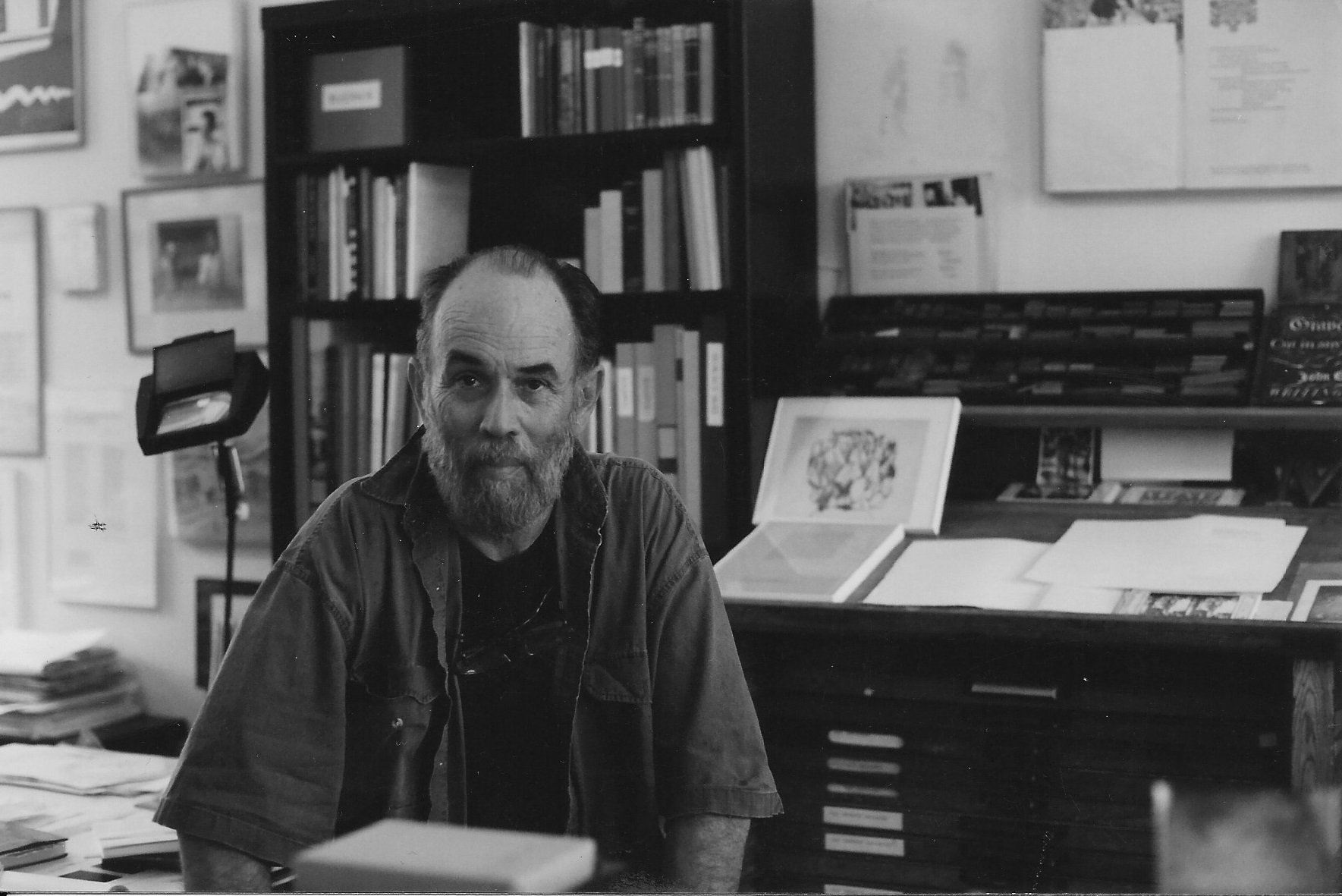
Gus at Jack Stauffacher’s Greenwood Press San Francisco 1986

1999

 Published as “A Vigorous Lucidity” in A Typographic Journey: The History of the Greenwood Press and a Bibliography, 1934 – 2000, San Francisco, Book Club of California, 1999. This version is from an undated computer print-out manuscript inscribed with marker: “Stauffacher / Book Editing History.”
Rainy Mountain —- a journey

Stanley Crawford R.I.P.

October 2, 1937 – January 25, 2024

                          Photograph by Don J. Usner

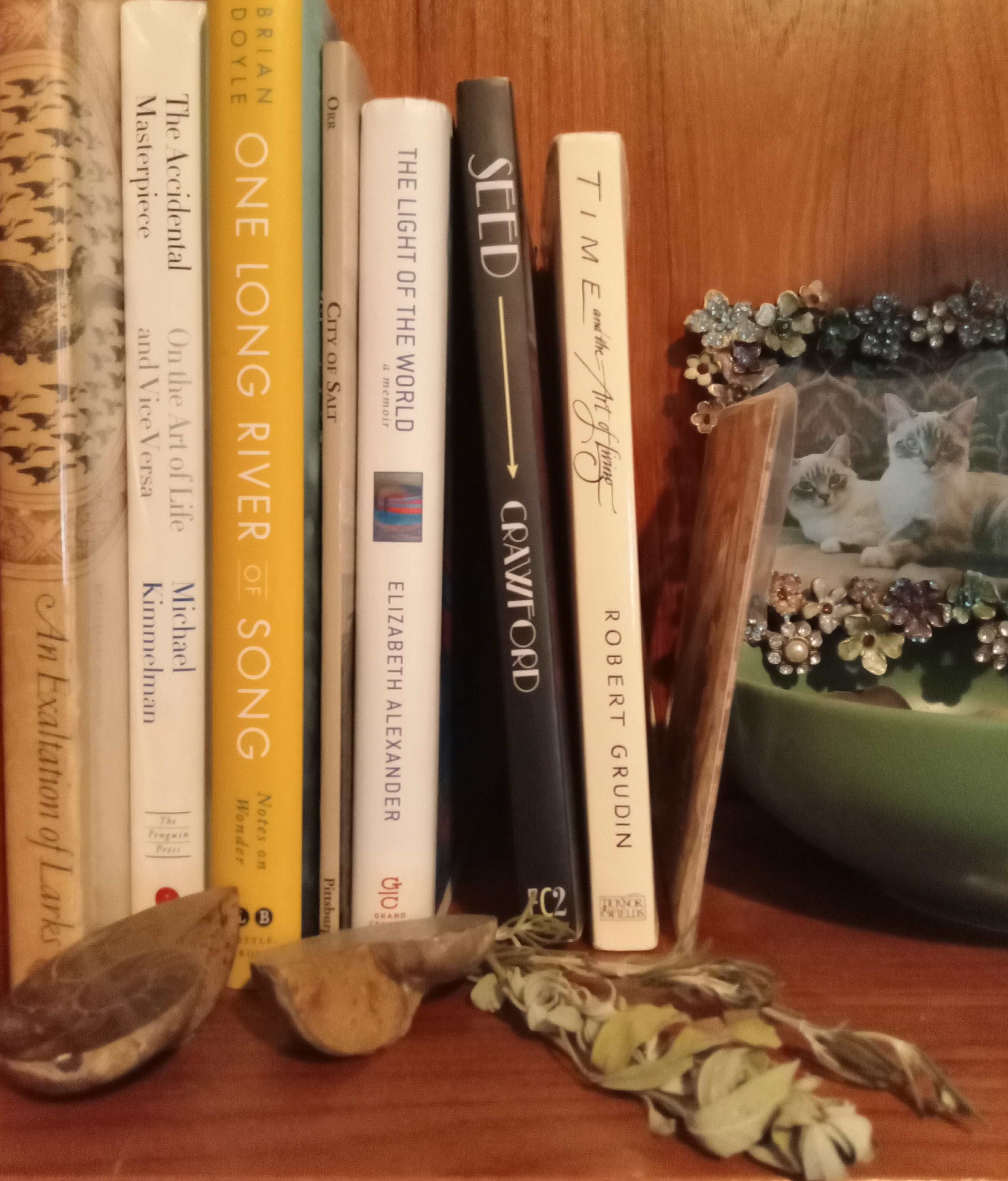
Eternally grateful for all the SEEDS dear Stanley      

love, Nicole

FRAGMENTS

Gus becomes friends with Stanley and Rose Mary Crawford in the 1970’s.       He champions Stanley’s writings for the rest of his life.

Gus sends Stanley Crawford’s memoir Mayordomo to editor and friend Beth Hadas at the University of New Mexico Press, where it is published in 1988 and wins a Western States Book Award. 

Elizabeth Hadas editor UNM Press     Photograph by Nicole Blaisdell Ivey

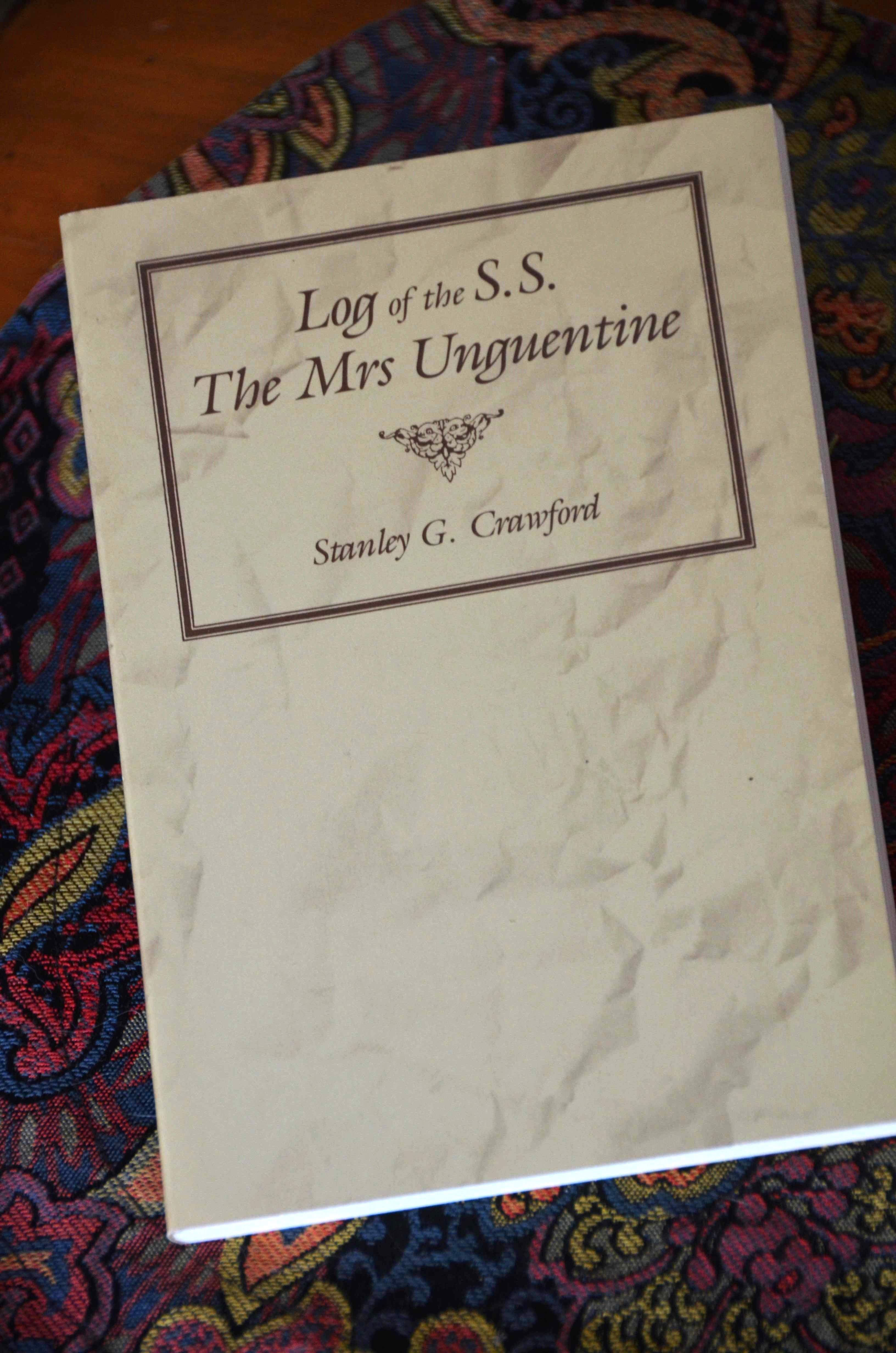
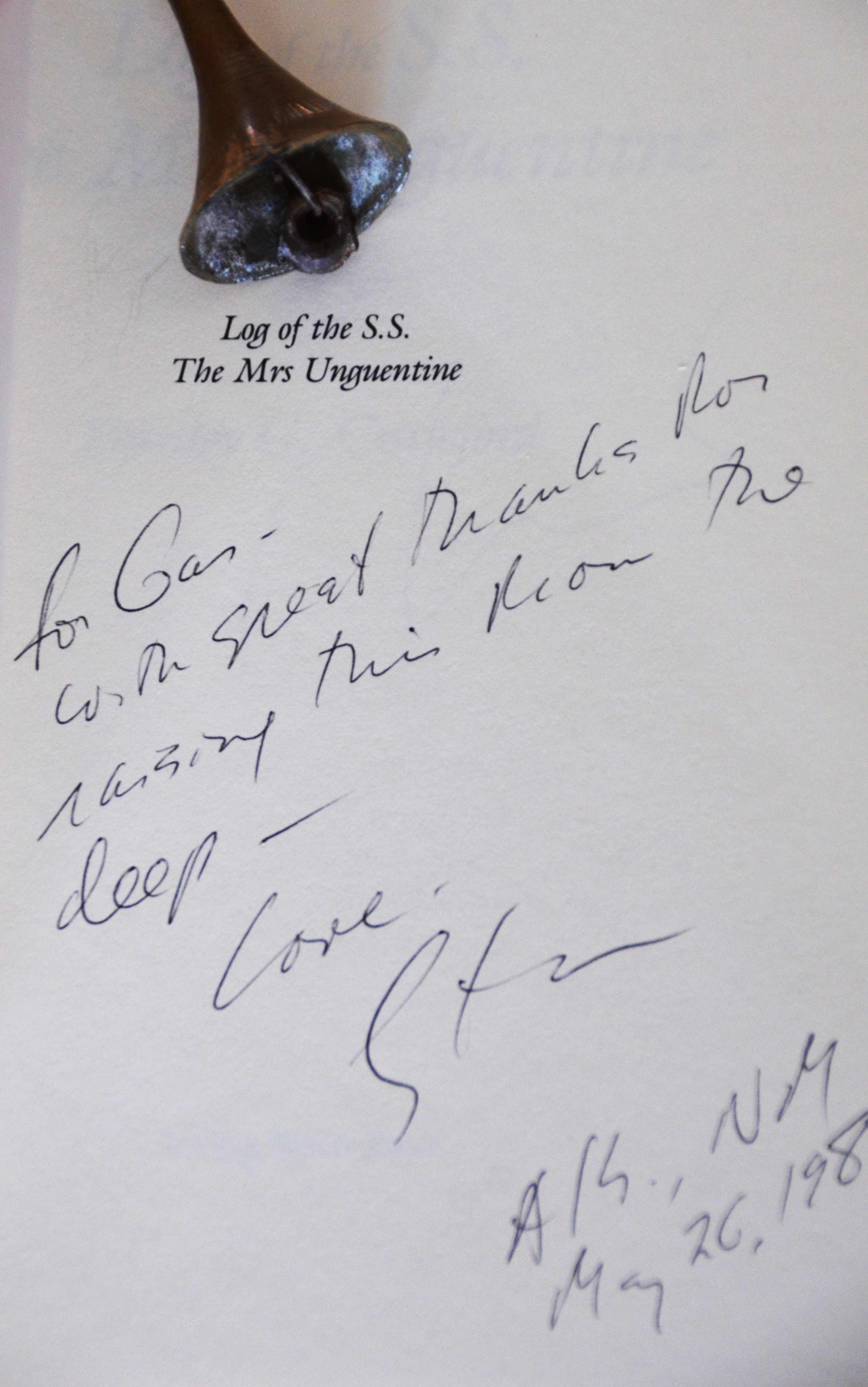
Gus reissues Crawford’s 1972 novel The Log of the SS The Mrs Unguentine, the first under his Living Batch Press imprint.

From the LIVING BATCH NEWS, “LIVING BATCH ENTERS PUBLISHING…The first two (books) are Stanley Cavells’ THIS NEW YET UNAPPROACHABLE AMERICA and Stanley Crawford’s classic and long-unattainable LOG OF THE S.S. THE MRS. UNGUENTINE… Reasons for the press?  To make some of what we believe in and to produce at reasonable prices and in typographically handsome (readable) formats lost (and original) books of lasting interest..A simpler reason is enthusiasm. When I read Cavells’ lectures on Wittgenstein as a cultural philosopher and Emerson as finding and beginning the founding of American culture, I felt that if I ever wanted to publish, here was an opportunity not to be missed.  For years, I have tried to interest publishers in printing Crawford’s novel…With Cavell as foundation and Crawford as the first couple of bricks I had more than I needed to move on.  I trust such conviction will continue and the little wall of books will stretch like a new course of masonry, brick by brick, book by book, until we have a foot or so of or own choosing on ours and others’ shelves.

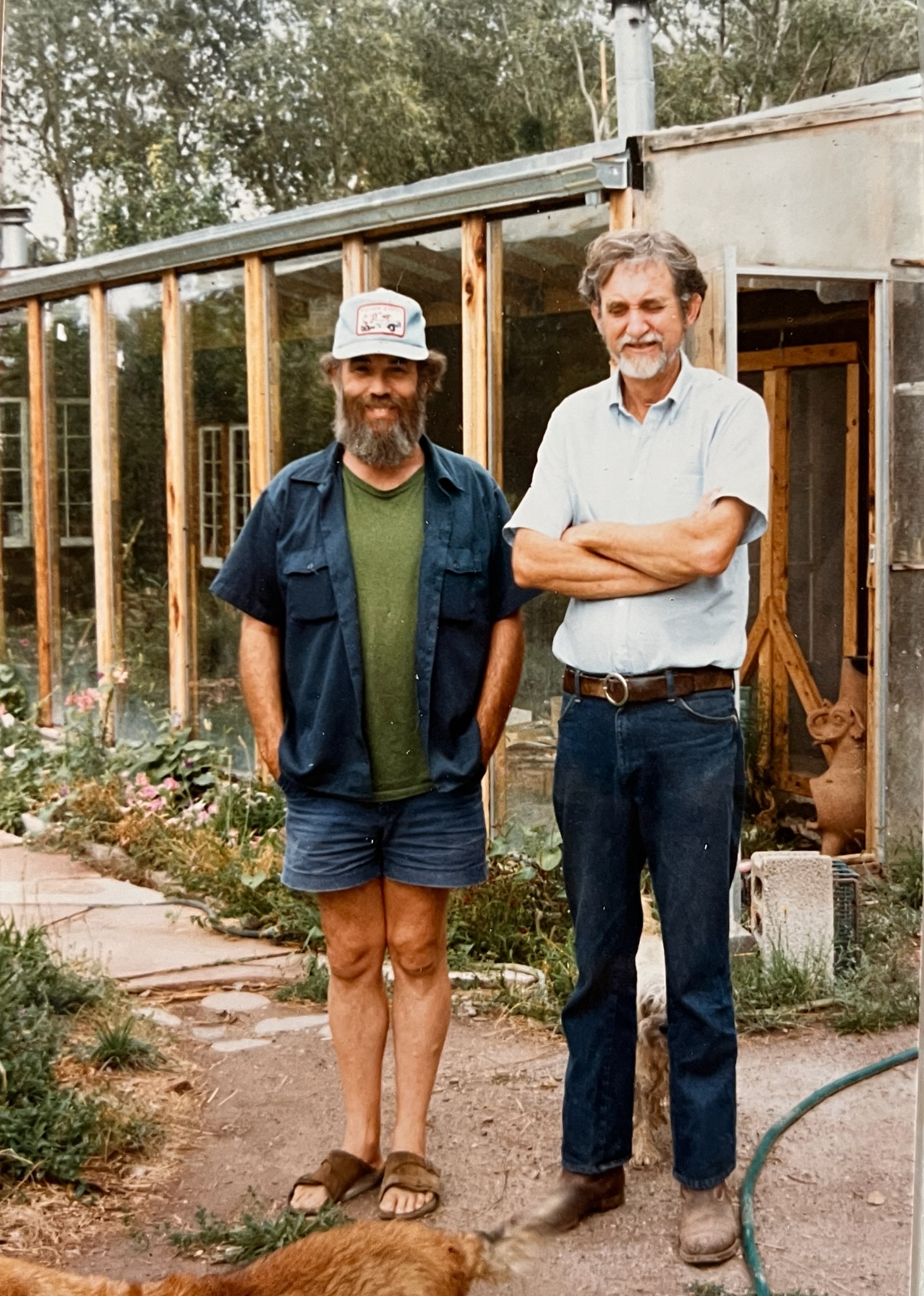
Gus and Stan at El Bosque Garlic Farm

Wonderful tribute/story/obit published by the Santa Fe New Mexican-

Dixon Garlic Farmer, Revered Author Stanley Crawford Dies at 86

“He was totally brave, totally ready, and was very, very graceful about it”

Stanley Crawford at his home in Dixon. Photo by Don Usner. With permission from Katya Crawford.

By Julia Goldberg January 31, 2024 at 5:38 am MST

“A farmer-writer who loves garlic as much as words” is how the New York Times described Dixon writer and farmer Stanley Crawford in a 2011 story, and one might be hard-pressed to improve upon that characterization.

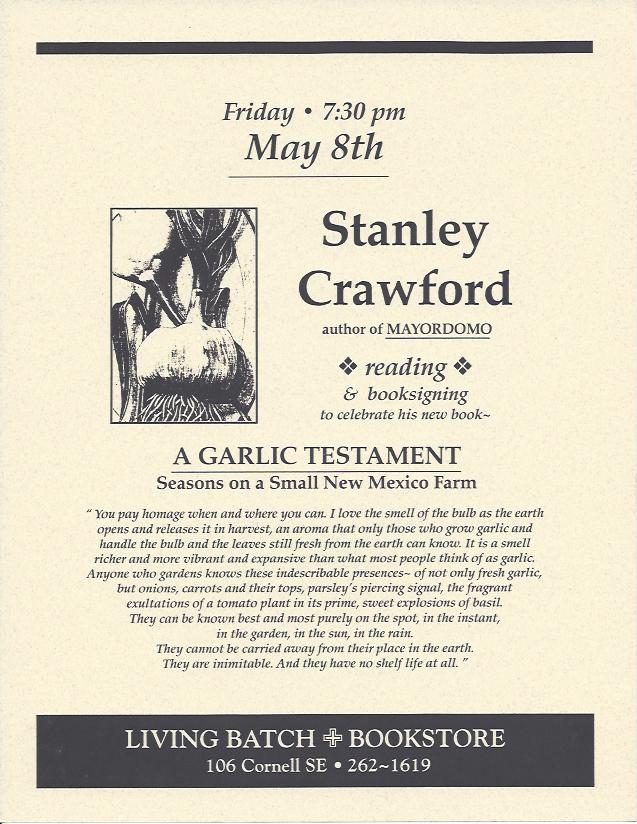
Crawford, whose 11 books included the seminal and award-winning memoirs Mayordormo: Chronicle of an Acequia in Northern New MexicoandA Garlic Testament: Seasons on a Small New Mexico Farm,died Jan. 25 at his home in Dixon as a result of a medically-assisted death he chose after learning earlier in January he had untreatable cancer, his daughter Katya Crawford tells SFR.

“He was totally brave, totally ready, and was very, very graceful about it,” says Crawford, who was with her father when he died, along with her brother Adam and his wife.

After learning he had advanced liver, kidney and colon cancer at the start of January and making the decision to decline treatment, Crawford spent the last few weeks of life talking to friends and family.

“He was able to speak to so many people that he loved and let them know that he was dying,” Katya Crawford says. “For three weeks before he died, he was able to see people every day or talk to people on the phone all around the world.” And while he had trouble walking toward the end and was very weak, “he was never in any pain,” she says.

In fact, up until last year, Crawford was still farming El Bosque Farm in Dixon, where he and his late wife, Rose Mary, who died three years ago, moved in 1969 and raised their children. Katya Crawford was born in Embudo, while Adam was born in Ireland, where Stanley and Rose Mary were living at the time.

Up until last year, her father remained on the electric co-op board, Crawford says. “He was traveling to conferences and to Washington DC. He was doing the Farmers Market. He taught at Colorado College in October; he could barely walk and his students loved him. That was in October. He was just living life very, very fully. He was surrounded by lots of young people and lifetime friends.”

Though his death naturally was hard to prepare for, she says, “my dad lived a really awesome life.”

Stanley and Rose Mary Crawford with their pet Magpie. Photo courtesy of Katya Crawford

Crawford himself was born in 1937 and educated at the University of Chicago and at the Sorbonne. He wrote his first novel, Gascoyne, while living on Greece, and it was optioned for film.

That was “probably the only time he had money,” Katya says of her father. He had “a pretty intense obsession with automobiles” and bought a Mercedes. He, RoseMary and Adam were living on Ireland and took the Mercedes on a ship back to New York, where they drove it across the country. He left behind a Bentley, a Ford Model T and a vintage tractor, she says. After returning to San Francisco, the Crawfords went to visit friends in Northern New Mexico and ended up buying land and staying there.

Stanley Crawford also left behind two aging Blue Healers, a Corgi puppy named Pippa and approximately 35 geese, ducks and chickens, she says. Decisions about the farm’s future have not been made.

“We’re not going to make any rash decisions,” she says. “We both grew up in that house. It’s incredibly sentimental to us. I worked there even when I was in college, I would go back in the summer time to work on the farm. I went to the farm almost every weekend to take care of my mom, lots of times in the summertime to take care of my mom and then my dad. So we’re very attached to that to the property and to their legacy. It’s also kind of a painful place to be without them.”

In 2019, Crawford published The Garlic Papers: A Small Garlic Farm in the Age of Global Vampires (Leaf Storm Press), which documents the massive legal battle that pitted his small farm in New Mexico against a Chinese garlic importer and its several international law firms, also the subject of a Netflix documentary, “Garlic Breath,” in the six-part series Rotten, released in 2018.

“The news about Stan’s passing came as a shock,” Leaf Storm Publisher Andy Dudzik (a former longtime SFR publisher) tells SFR via email. “As a writer, he was a singular talent and an absolute joy to work with. It was an honor to be entrusted with publishing two of his books. He was also one of the most gentle and humble souls I’ve ever known, and I will miss him greatly.”

Stanley Crawford made this desk, at which he wrote his first novel, “Gascoyne,” in Lesvos, Greece. Photo courtesy of Katya Crawford

Leaf Storm also published Crawford’s 2017 novel Village, described by the late author John Nichols as “vintage Crawford…true to life…love, death, sex, depression, poverty, ditch cleaning, love of automobiles, teenage craziness, bits of euphoria…all mingle with the natural world through which the human community stumbles.”

In a 2017 interview with Lorene Mills on Report from Santa Fe, Crawford said he wrote the novel as “a love letter to my village.”

Katya Crawford says he favorite of her father’s books is the 1972 novella Log of the S.S. The Mrs. Unguentine. Chair and Associate Professor in the Landscape Architecture Department at the University of New Mexico’s School of Architecture, Crawford says when she was doing her master’s degree in landscape architecture, she had an assignment to design an island and designed the garbage barge from the novella, which describes, in the form of a ship’s log, the 40-year history of the Unguentine marriage at sea on board a garbage barge. Upon its reissue several years ago, the Los Angeles Times wrote “the book is long overdue for a heroic homecoming.”

Stanley Crawford also left behind one unpublished novel, Katya says, which his agent will work on selling to publish posthumously. His remaining archives will go to UNM.

Before her father died, she asked him if he wanted to write his own obituary. He said no; he was too tired. So she asked if there was any particular message he would want that obituary to include.

“Friendship are everything,” he said.

She told him that was her mother’s line and not “very original.” And he laughed and understood but then repeated the sentiment: “I’m serious,” he said. “Friends are so important.”

And he had so many, Katya says. “He had a really good life.”

Katya Crawford shot this photo of her dad, Stanley Crawford, on Jan. 12. He kept his sense of humor to the end, she says.

“You pay homage when and where you can. I love the smell of the bulb as the earth opens and releases it in harvest, an aroma that only those who grow garlic and handle the bulb and the leaves still fresh from the earth can know. Anyone who gardens knows these indescribable presences—of not only fresh garlic, but onions, carrots and their tops, parsley’s piercing signal, the fragrant exultations of a tomato plant in its prime, sweet explosions of basil. They can be known best and most purely on the spot, in the instant, in the garden, in the sun, in the rain. They cannot be carried away from their place in the earth. They are inimitable. And they have no shelf life at all.”

― Stanley Crawford, A Garlic Testament: Seasons on a Small New Mexico Farm

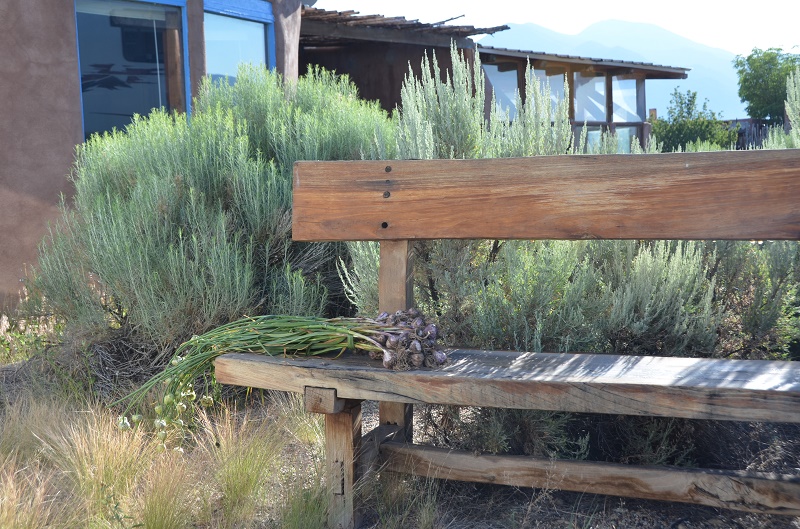
My son Jack Augustus (Gus’ grandson) and I are lucky enough to spend a fine hot day picking garlic with Stan, who at 81 years old, silently gives us a lesson in endurance and, of course, enough fabulous fragrant garlic to share with family.

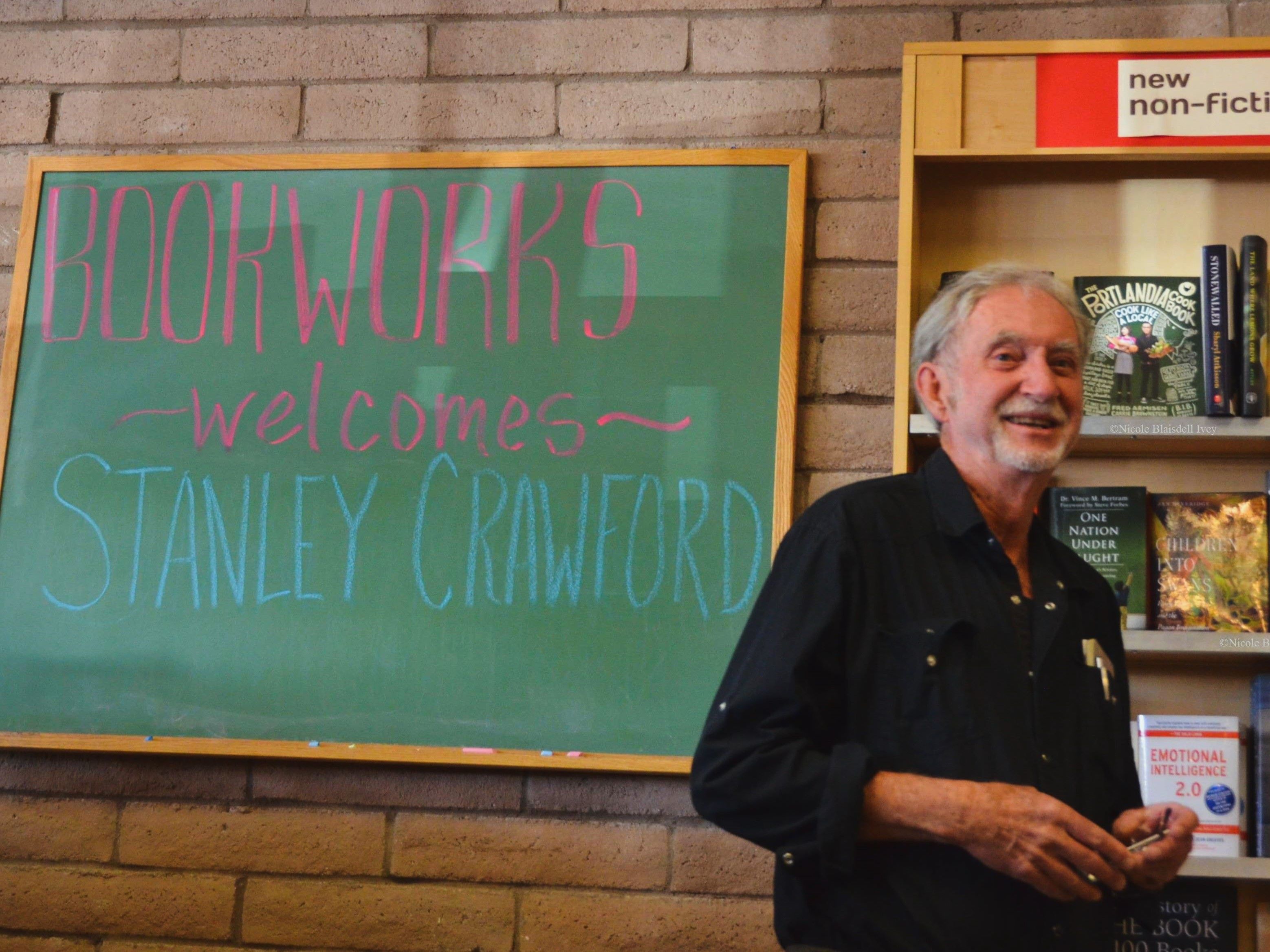
Stanley Crawford reads from SEED at BOOKWORKS- 2015     
Albuquerque, New Mexico     Photo by Nicole Blaisdell Ivey

Hello Stan,

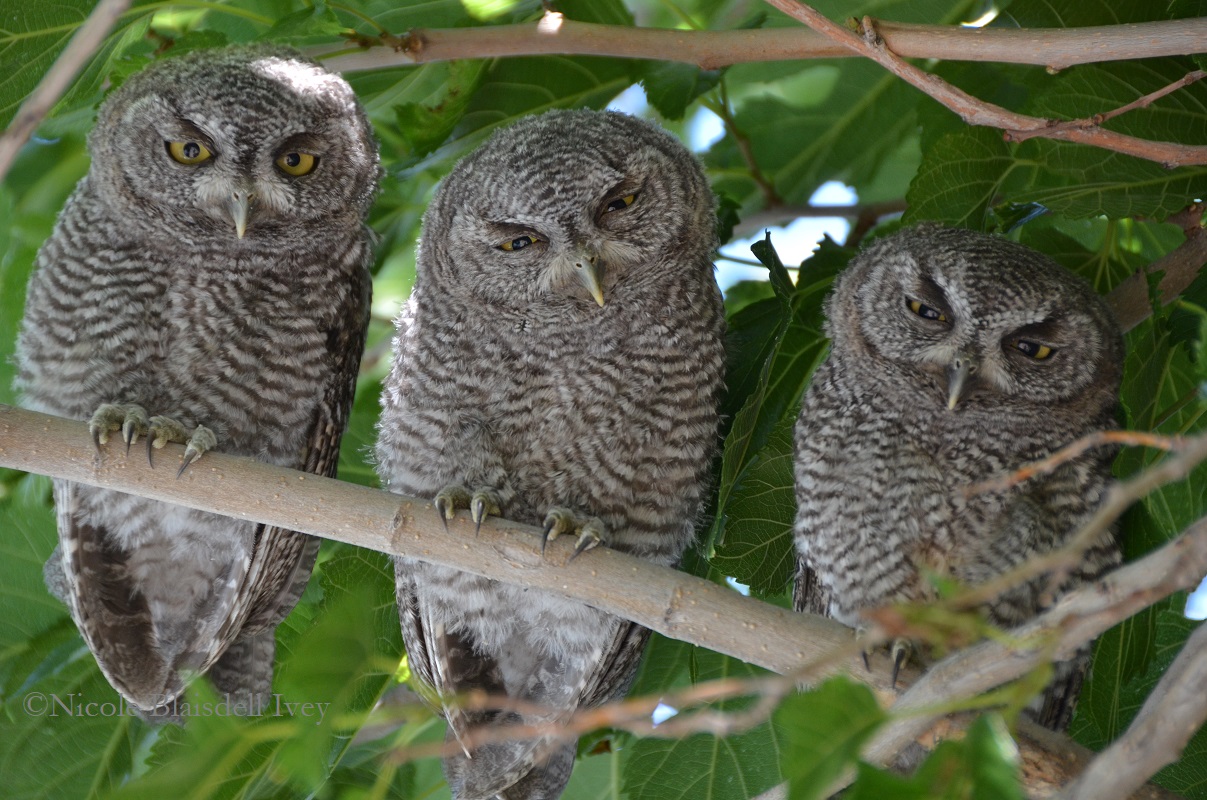
For a week now five Screech owls have perched in our overgrown backyard mulberry tree. 

Gold orb eyes stare back at me. Feels like a visitation from ancient gods.

City girl photographer tries desperately not to abuse their daytime rest 

with camera clicks and lonely sighs. 

Last night finished reading SEED for third time. 

Such good company.

How are you? Garlic? etc…

love and gratitude,

Nicole

In February my husband and I drive to Dixon to take Stan to lunch and visit with him at his home. We’d sadly missed Rose Mary’s memorial celebration having been exposed to Covid and not wanting to infect others.

     _______________________________________

We pull into Zuly’s little dirt parking lot. Stan unfolds his lanky self from a sleek silver car, a stark contrast to his dusty black jeans and faded plaid flannel. I hug him, my head nestling in at his heart. He laughs. He reaches to shake Mark’s hand. “Good to see you.” In two steps I say “Oh” , and turn to hug him again. He takes it. “That one’s from Janet.”
Stan smiles, “It’s been a while since I’ve seen her,” he looks towards the scrubby hills, “two years since Rosemary’s death. At the celebration I believe, in the summer.” He pulls open the restaurant screen door. “First day they’re open this season.”

The dark-haired woman greets Stan warmly in Spanish and English. They catch up, swinging words back and forth between them, between languages.

We order Carne con Chile and sandwiches.

We sit at the formica wood tables, in the black padded metal chairs and tell stories. Mark talks climate. Stan says, my friend David read the new book by William de Buys. It’s a small one. He’s gone to Nepal to walk around and behold the natural world. He says the planet is in hospice.” 

We walk out of the deli and into the sunshine, light bounces of the car hood.

“Come back to the house,” Stan says.

I put on my sunglasses and hand Mark my keys. “I’m riding with him.”

Stan folds himself back into the driver’s seat. I wait as he clears the papers, books, tools, choice sticks, rocks and feathers off the passenger seat.  I climb in, see the screen, look around the interior. “What kind of car is this?”

“It’s a Tesla,” he says tapping the screen and backing up.

“Oh, I’ve never been in one.”

“Let me show you what it does.”

Stan transports us from zero to so fast on that little country straight away that I inhale a squeal, my stomach butterflys , and I yell, as if increased speed requires an equal increase in volume.

“Don’t’ stop. Keep going. I don’t have to be back for two weeks.”

He laughs as he slows before the curve out of town.

Back at El Bosque Farm in the adobe house that he and Rosemary built by hand, we sit and talk in his paper strewn living room where dogs wag and hop up on couches for love.

“I should have invited people over even though it was hard”, he said. ” It would have been better. Everyone just stopped coming by.”

We sit in silence. Think about the slow loss of his vivacious wife’s memory ten years before she died.

Mark and I stand to go, to head back for my shift with my mother who thinks I’m her high school girl friend.

Stan says, “Let me get you some garlic.”

DISCUSSING GUS Dec. 5th 4pm UNM bookstore

gus scarf

         Please join editors William Peterson and Nicole Blaisdell Ivey for a discussion and book signing of GUS BLAISDELL COLLECTED Wednesday 12/5  at 4pm

Message from Momaday

                          A note from Pulitzer prize-winning author, N. Scott Momaday, discussing the GUS BLAISDELL COLLECTED book (Gus was UNM Press editor on Momaday’s second book, The Way to Rainy Mountain, published by UNM press).

Dear Nicole,The book is a clear mirror of the man. It is beautiful and moving. Gus and I made a legendary journey to Rainy Mountain in the hard weather that shapes mind and memory. It was a quest, a journey eminently worth making.With deepest thanks.Scott


In Gus’s  “Holygraph” book (a blank dummy book for Ivor Winters’s Forms of Discovery run, filled with friends poems, drawings, autographs and insights) 

Scott writes,

“Dear Veering,
It has been good to be
with you on the way to Rainy
Mountain. One day you must
go to the cemetery there, to
see the gravestones of some of
these red people you must at
times feel that you know.
And I hope that the
weather is particularly hard
on that occasion.


N Scott Momaday
Christmas Eve 1968
"


Gus writes,


"On an Inscription in my Holygraph Book
for Scott.

We have/ been tog/ether/ now these/ many/ months
each on his way to Rainy Mountain, a journey
taken in fact, in spirit, and imagination.
It is a labor of love without loss, finding
my way, finally, to that dark stone
that bears your grandmother’s name.

You wish me the hardest weather on my visit
Such weather is the weather of my spirit,
A semiarid terrain wild with winds, and,
At evening, reason’s rage and fury flaming,
When the wind blows and wind bells ring
Or the snow falls down and no bell rings."


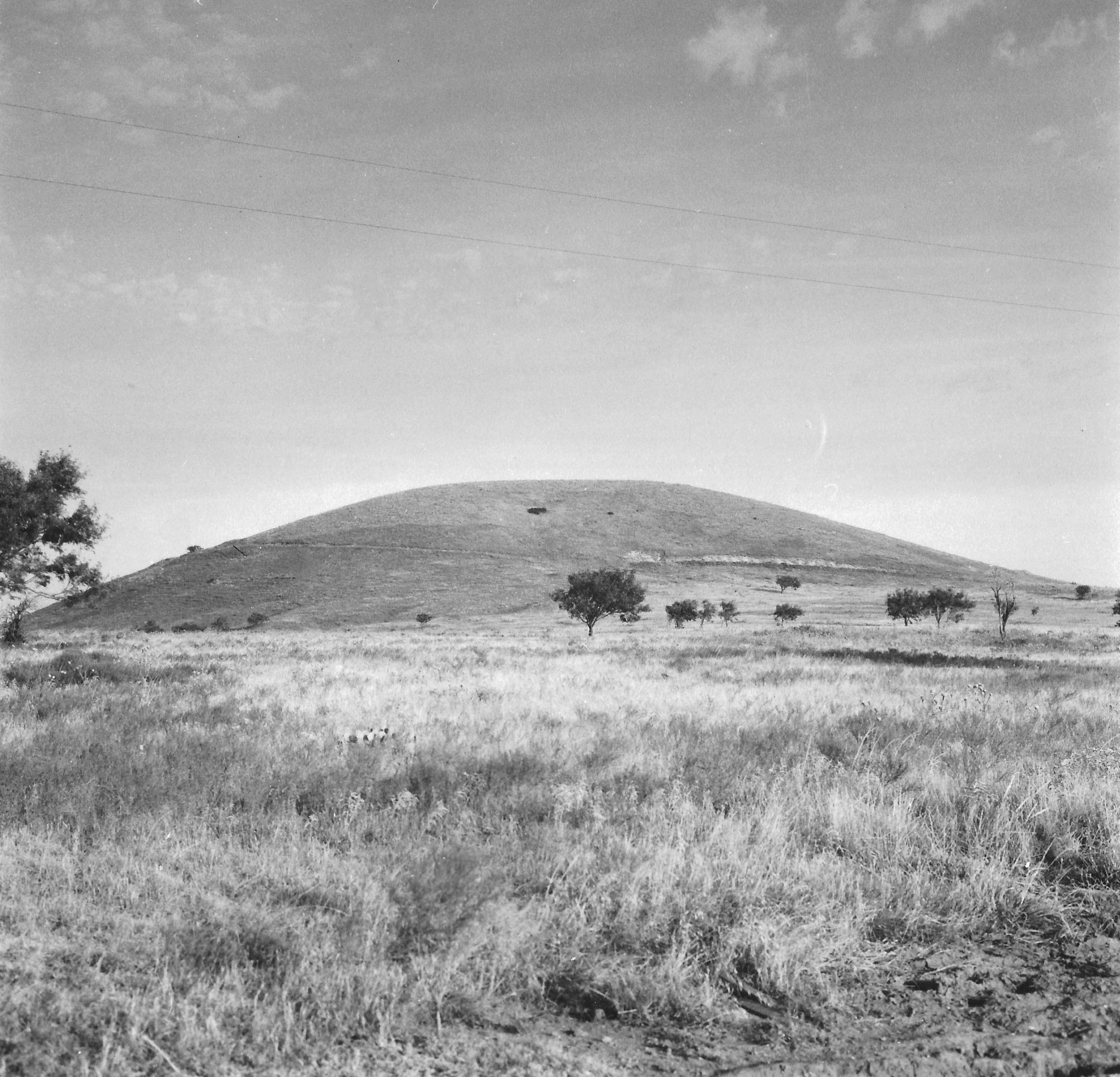
Rainy Mountain                   from the archive of Gus Blaisdell

N. Scott Momaday, Pulitzer-Winning Native American Novelist, Dies at 89

https://www.nytimes.com/2024/01/29/books/n-scott-momaday-dead.html