“Loss is forever but so is Love” poet Ken Fields

I’m well (just had a brief fling with the flu).  Montaigne reminds us that we die because we’re alive, not because we’re sick.
Poet Ken Fields Photo by Nicole Blaisdell Ivey

Lovely Ken,

Just finished Blue Plataea Part I on this quiet birdsong morning.

Roshi, good black dog, biggest radar ears on the planet,

tilts his head at the sound of

Pleiades in my cup

So many images to savor

thoughts to see

love to you dear Ken,

Nicole

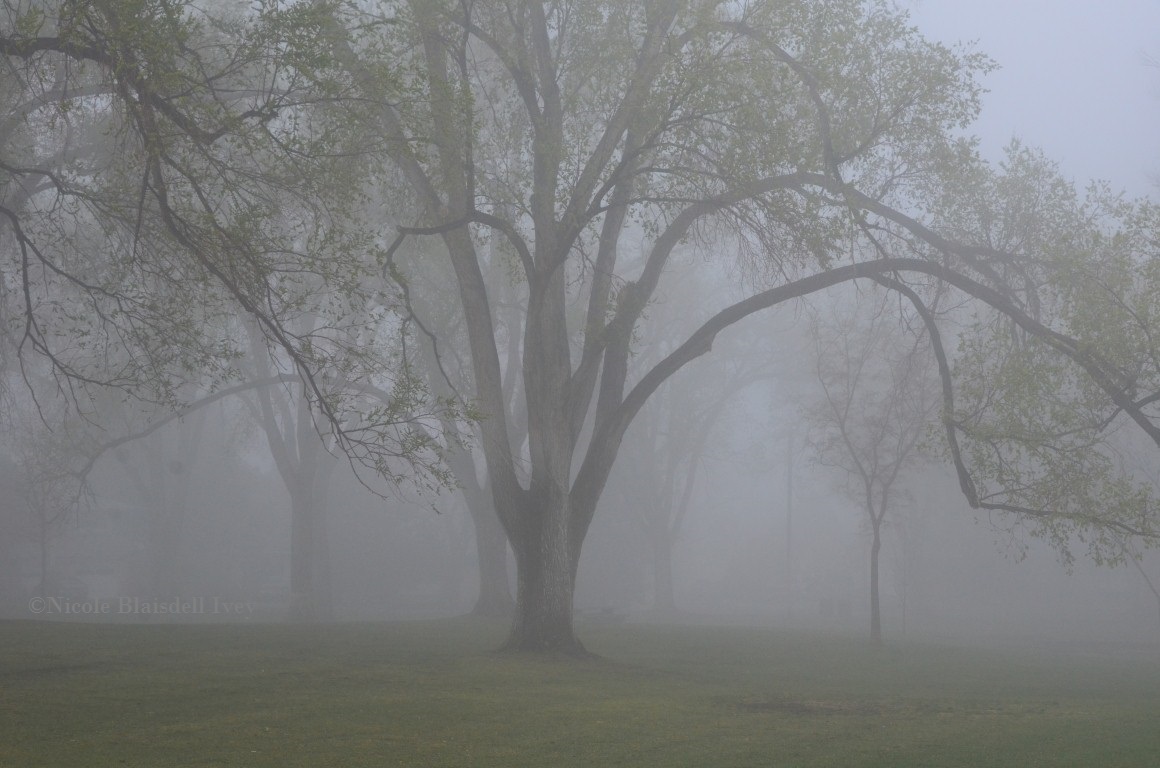
Searching Pleiades by Nicole Blaisdell Ivey

Thank you for all your kindness and generosity through the years after my father died.

Thank you for your poetry. You bring his spirit back every time I read your poem.

____________________________________________________________

Gus

  Albuquerque, NM

    “Earth angel, earth angel, the one I adore”

        –The Penguins

Ten months after your death I got the news.

All that time you were still alive.  Each week

I thought of you or told a Blaisdell story,

The way I saw you first, at my front door,

Six hours late, the middle of the night, festooned

With leaves in your hair from the back yards you’d crashed through

As curly haired as Bacchus and as stoned:

“Your neighbors don’t know you, man”—you kept shouting,

“Professor Fields, goddamn it.”  The next three days

We talked and drank around the clock, the only

Trace of that conviviality, the phrase

“Far fuckin’ out!”  We said it a thousand times,

Late sixties eloquence, we never looked back.

We burned our lives to the rail, in a few years,

You sobered up and in a few more, me too.

From then on we remembered what we said.

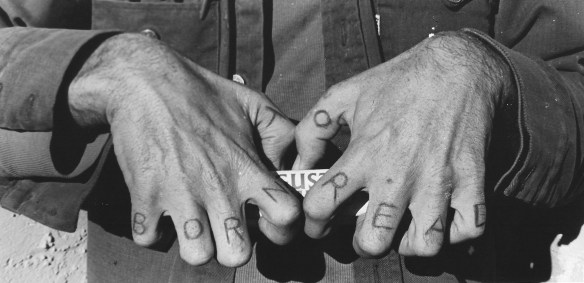
You got to Stanford through a pachuco gang

In San Diego, tattoos on the backs of your fingers.

Arrested for stealing a book, you finished high school

In a bad boys joint run by the nuns.  The bookseller

(Later your trade) thought about what you’d done—

He’d never had a thug steal Wallace Stevens,

So he sent you all the Stevens in his store

And In Defense of Reason, strange remorse.

This Winters is smart, you said.  You came to Stanford

Where Uncle Lumpy, as you called him, loved you.

Your master and mine, he called you his wild boy.

One day the dean of men confronted you.

He’d just found out about your tattoos.  “This school

Is a gentleman’s school, and I expect you to act

Like one, at least, and not come back next term.

We’ve never had anyone like you.”  When you told Winters,

He stood up, pushing his chair into the wall,

And stumped across the quad.  “I never knew

What he said to the dean.”  Hell, you know what he said,

“This boy is ten times smarter than you.  He stays”

You only taught the best:  Mrs. Bridge,

Basho’s Narrow Road, Kurosawa,

Chris Marker and Descartes’ Meditations:

“Wrong in every one of them, but read them

Like a French New Novel, narrated by a man

Trying to keep from going mad, and failing.”

You were my only intellectual.

                                                  Your charm,

Your beautifully vulgar equanimity,

Brought learning to the table and the street,

“Where the rubber meets the chode,” I hear you laugh,

The rude road Strode rode.  In that quick riff

You’d hear John Ford, Woody, and Sonny Rollins,

And the Duke holding court at The Frontier,

The all-night diner where you said good night.

When you described a round bed with a bedspread

Printed with a target—“it was like ground zero

At a fuckathon”—my wife fell in love with you,

“The funniest man alive.”  And you still are.

“Not too many words between myself

And the world outside,” you wrote.

Well, more than you let on.  A single room

Is overflowing with them, “Some white puff

Just beyond our mouth.”  I want to phone you

When a doctor tells me of a patient complaining

Of fireballs in her universe, another

Suffering immaculate degeneration,

And a man controlling his rage by taking something

He called Hold Off.  But no one’s home.

                                                                  Gus,

Fireball, immaculate degenerate, you hold off,

You’re somewhere out there, as they say at Acoma

(Simon Ortiz recalls you at Okie Joe’s),

You’re somewhere out there, Gus, or as you’d say it,

(Corazon, baby) you are far fuckin’ out.

Ken Fields 2005
Blaisdell Ablaze

Gus Blaisdell 1935-2003

We talk about Terrence Malick in Heaven

It’s eight years since you left the world. The Tree

Of Life has come and gone. Birds fly

To creation, others to extinction, yet one

Trembles here

On this branch, now. Light and water

Burst forth in Texas—origin… there is no

Origin here—only music and Dante’s spirit

Guide, portal

Through which we infer eternity,

Our own making, a raft on fire

Refulgent on the thin film it rides upon,

Both gateway and end

Ken Fields – 2012
Before the Word — photo by Nicole Blaisdell Ivey

Kenneth Fields, longtime English professor and acclaimed poet, dies at 84

Known for his insight and wit, Fields was one of Stanford’s longest-serving faculty members. He taught for 53 years.

March 11, 2024

Kenneth Fields, professor of English and of creative writing, emeritus, in the Stanford School of Humanities and Sciences and one of Stanford’s longest-serving faculty members, died Dec. 6 from complications of amyotrophic lateral sclerosis. He was 84.

Fields earned his doctorate in English from Stanford in 1967 and joined the university’s faculty immediately afterward, retiring in 2020. During those decades, he published six poetry collections while teaching courses on creative writing, poetry, and film.

“He was one of the best raconteurs I have known,” said Tobias Wolff, the Ward W. and Priscilla B. Woods Professor, Emeritus, and a former student, colleague, and friend of Fields. “When he finished telling a tale about old friends, family, university colleagues, or soldiers he’d served with, you felt as if you had shared a meal with them, or at least a drink.”

“In every breath could lie a poem”

While earning his undergraduate degree at the University of California, Santa Barbara, a poet introduced him to the work of Yvor Winters, a literary lion who was then teaching at Stanford.

Winters became an important mentor and colleague, and Fields became Winters’ student, collaborator, and even gardener. Fields described the experience in a Stanford Magazine story, writing that he would be working on a ladder when Winters would approach him, asking if he had read this or that poet.

“It was a great, if nerve-wracking, way to learn,” Fields wrote.
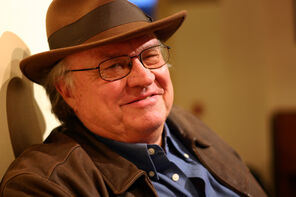
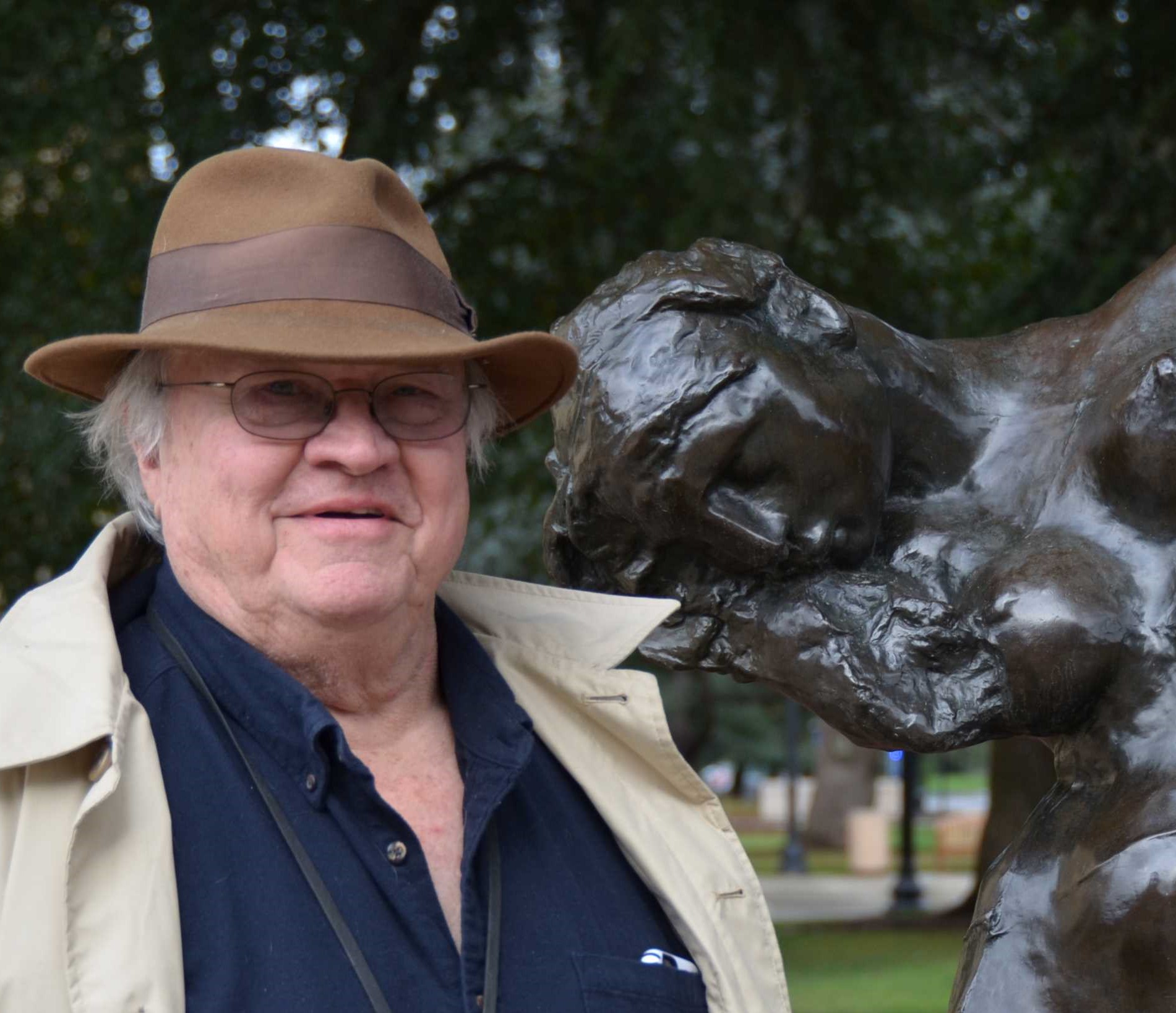
Kenneth Fields wearing glasses and wide-brimmed hat
Kenneth Fields. Photo by Laura Alice Watt.

In 1964, Fields received a Wallace Stegner Fellowship for poetry from Stanford. The two-year creative writing fellowship for poets and fiction writers was transformative for Fields, altering the trajectory of his career. After he received his doctorate in English in 1967, he began teaching at Stanford that same year. He later co-led the Stegner program as a professor.

Fields’ teaching varied from the cornerstones of poetry, including French symbolist poets and beat poets, to various forms of storytelling including American Indian mythology, American short fiction, and Western film. He even taught a course on the 20th-century American jazz standards, popular songs, and show tunes commonly called the “Great American Songbook.” His lectures featured a loose, freewheeling style that incorporated his trademark wit and a river of knowledge that ran both deep and wide.

He published six volumes of poetry, praised for their erudition and humor: The Other Walker (Talisman Literary Research, 1971); Sunbelly (David R. Godine, 1973); Smoke (Knife River Press, 1975); The Odysseus Manuscripts (Elpenor Books, 1981); August Delights (Robert L. Barth, 2001); and Classic Rough News (The University of Chicago Press, 2005). At the time of his death, he had been working on Blue Plateau, a collection of nearly 1,000 poems.

In recent years, his work had earned such accolades as Poetry Northwest magazine’s Richard Hugo Prize, awarded for his 2009 poemOne Love.

“In his writing and his teaching, Ken always had a great sense of form and language,” said Seth Lerer, Fields’ longtime colleague at Stanford who is now dean emeritus of arts and humanities at the University of California, San Diego. “He knew that every line of poetry should be a human breath, and that in every breath could lie, potentially, a poem.”

Lifelong poet

Fields was born Aug. 1, 1939, in Colorado City, Texas. At just six weeks old, Fields moved to his new home, San Luis Obispo, California, with his family.

After a childhood spent bicycling the California coastline, Fields attended the University of California, Santa Barbara, where he became the first college graduate in his family. He followed this by serving in the U.S. Army from 1961 to 1963. He married his wife, Nora Cain, in 1979.

Music, relationships, and poetry itself were important to him and were common themes in his writing, as was his experience with Alcoholics Anonymous—he went into recovery in 1982, an experience he referenced in Classic Rough News.

Fields taught the Advanced Poetry Writing Workshop for the Stanford Fellows for many years,and he never stopped writing poetry. In 2020, he composed a tribute after the passing of his poet friend Eavan Boland, the former director of Stanford’s Creative Writing Program. “Loss is forever, but so is love,” Fields wrote.

Fields is survived by his wife; his daughters, Erika Fields Jurney, Samantha Fields, and Jessica Fields; grandsons Henry Jurney, Ed Jurney, and Charlie Jurney; and his brother Don Fields and sister-in-law Ginger Rutland.

By Paul L. Underwood
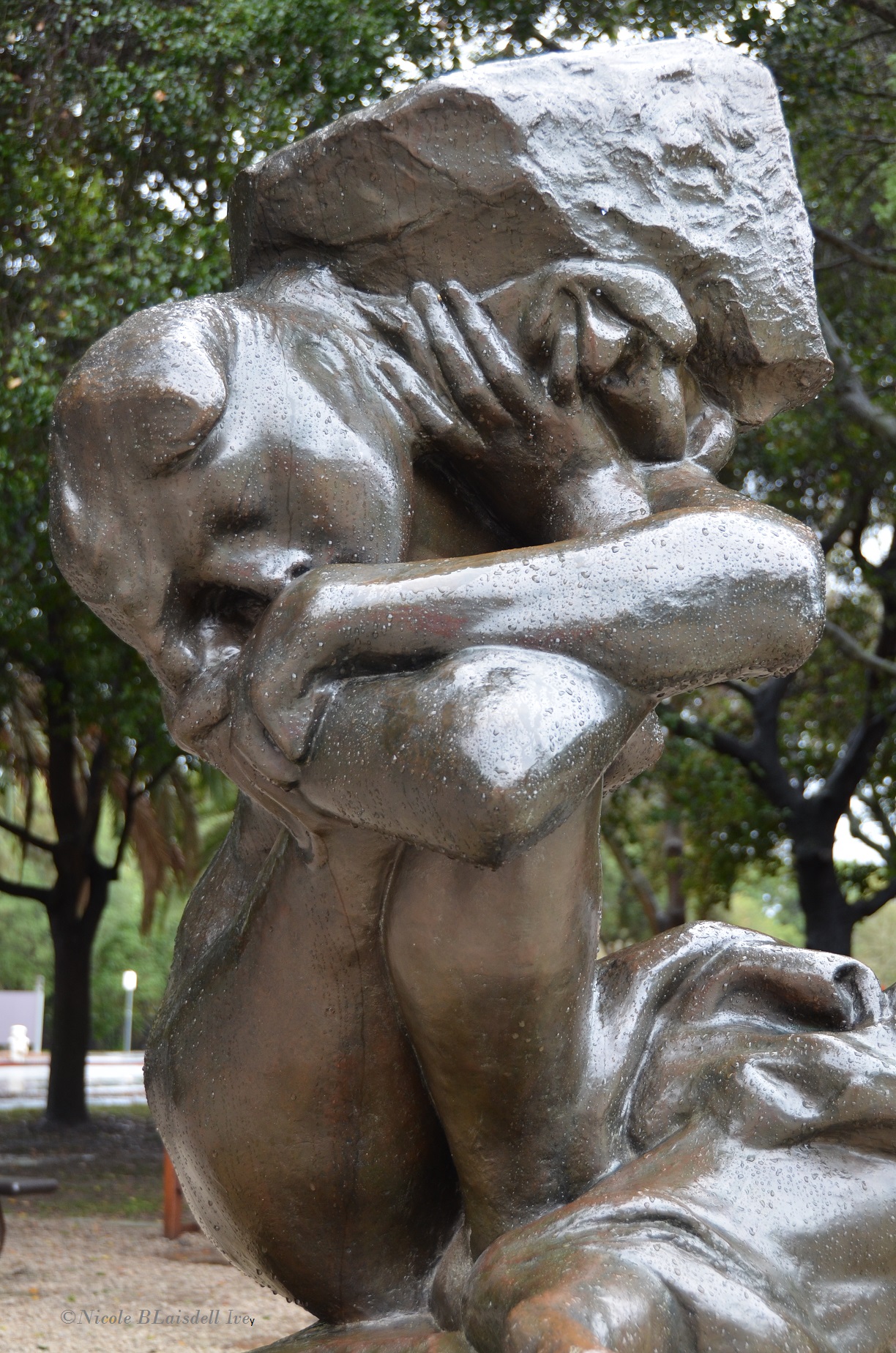
Rodin, The Fallen Caryatid Bearing Her Stone photo by Nicole Blaisdell Ivey

Omoide No Tsukimi             for Ronald Johnson 1935—1998

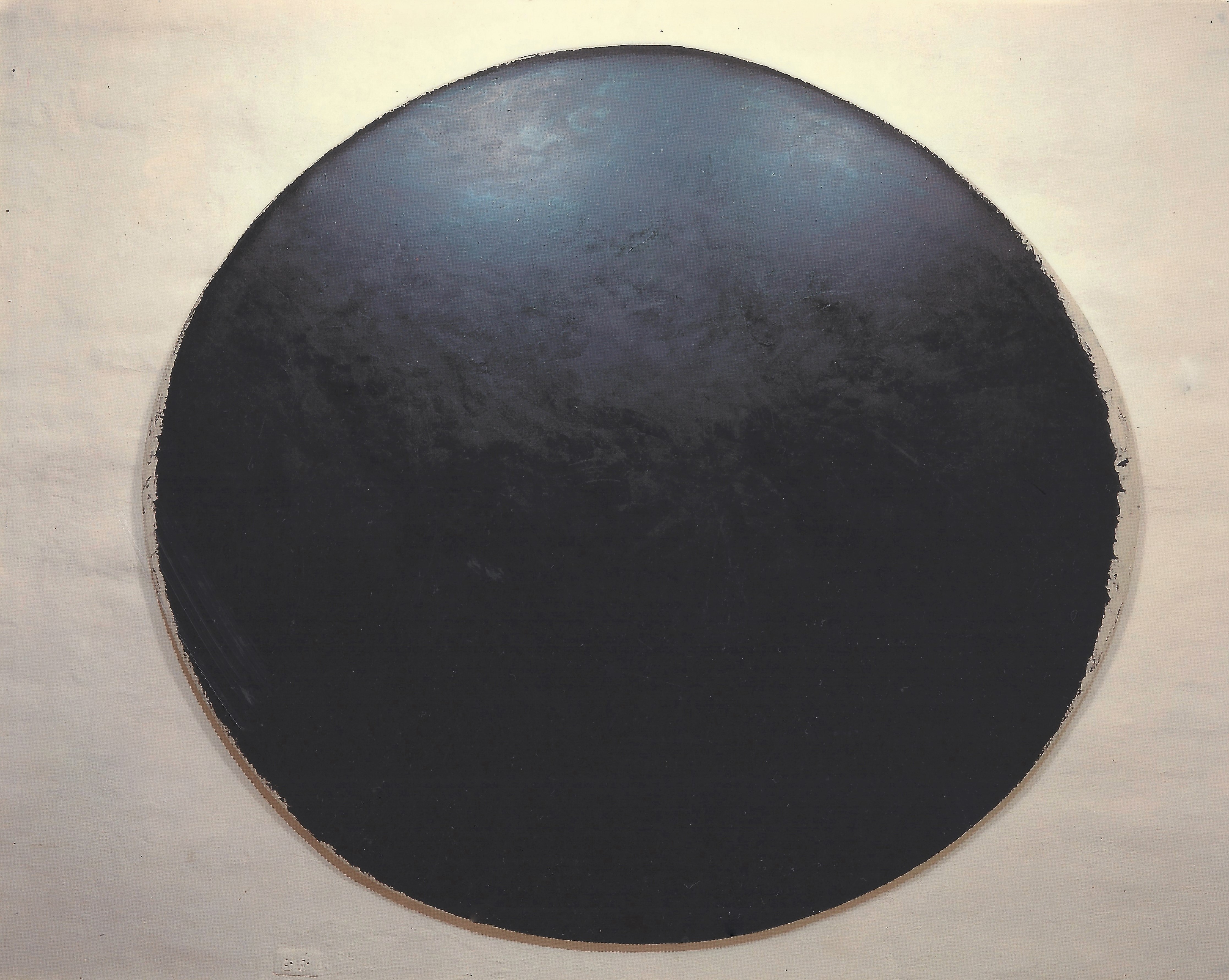
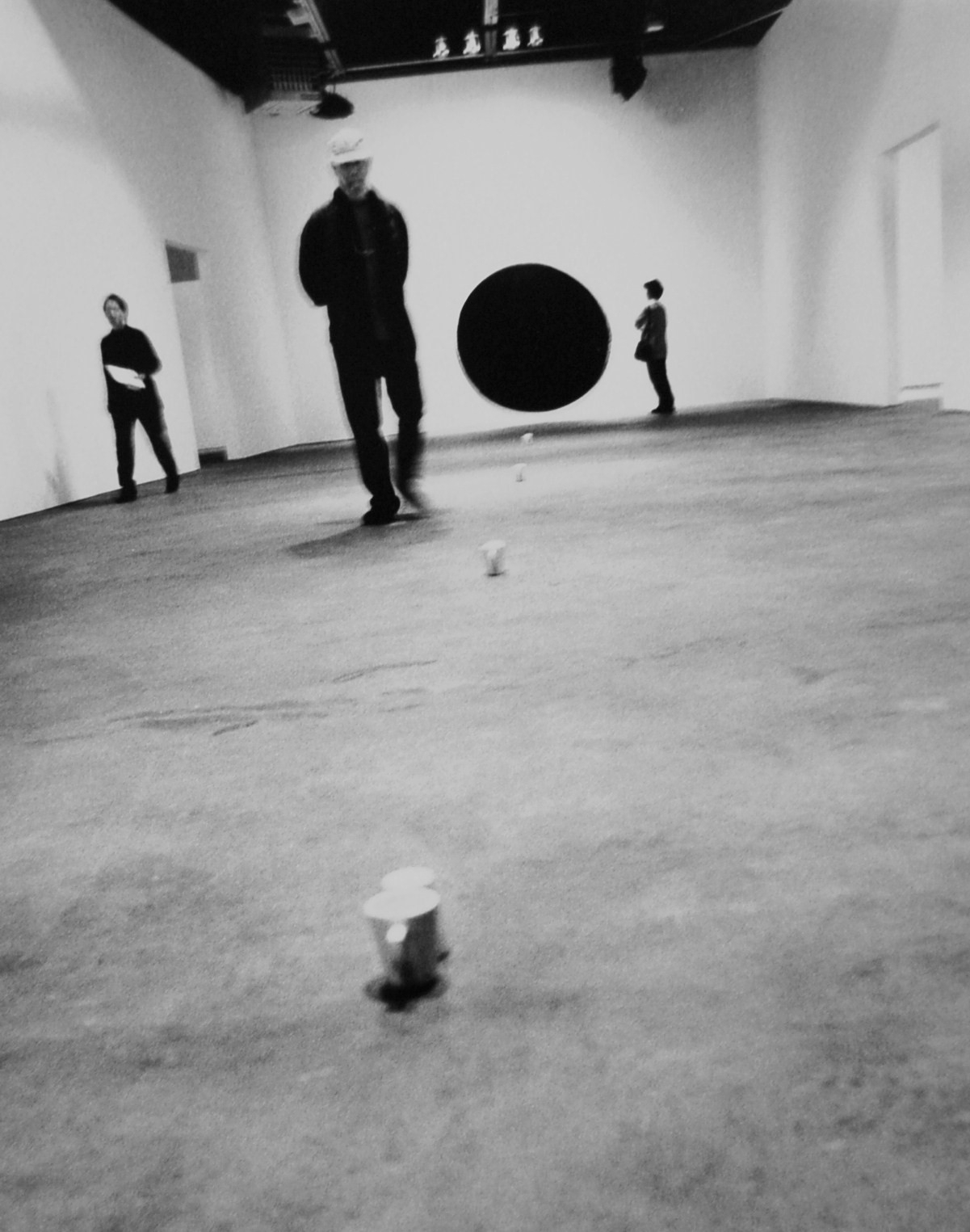
Allan Graham, Moon 2, 1986, oil on canvas, 83 in.x 91in. Private Collection

Omoide No Tsukimi             for Ronald Johnson 1935—1998

It rises to self-awareness          

Horizon that is always with us  

Black north’s direction

Risen from the belly nightsky   

Phantom blot, inkblack Heian hair

Coiled black pythoness

On moonless nights

Monk sleeves trailed through wet grasses

It hangs eternal there, never sets or climbs

Fulgent Moon 2, lightning struck through


Lightning flash

Then back to black

What seams this darklight

But black holds back, insists

At backbehindness it sustains

Unreflecting primordial companion

All phases of the moon condense

Moon 2 takes breathing, animates itself

Without horizon other than itself, irregular oval of all moons

Even when full or crescent sickle thin slice on either end


Blindspot

At last Narcissus lies faceless

Bottom of unsounded pond

Face buried in a silken muck

Thankfully in reflection I am dark to myself

Tarbaby reflections of Moon 2


Glitters in the total void

Senses steep in unsounded dark

Where darkbather mind

And sunbather eyes intersect

The heart is black and madder

The soul is fishscale black

Thunder underneath the under

Heart and soul begin a fisted journey

To the behindblackness

At our backs we always feel

Always back there behind it all

From head to heel black chrysalis

Hangman’s hood or shiny bodybag.

–Gus Blaisdell

Moon2 is an all black painting by Allan Graham. My Japanese title means remembering moonviewing. The line beginning “Thunder . . . ”, set in italic, varies a line from a manuscript, “The Imaginary Menagerie,” by the visionary poet Ronald Johnson. [Gus’s endnote.]

Larry Goodell: Co(s)mic Clown

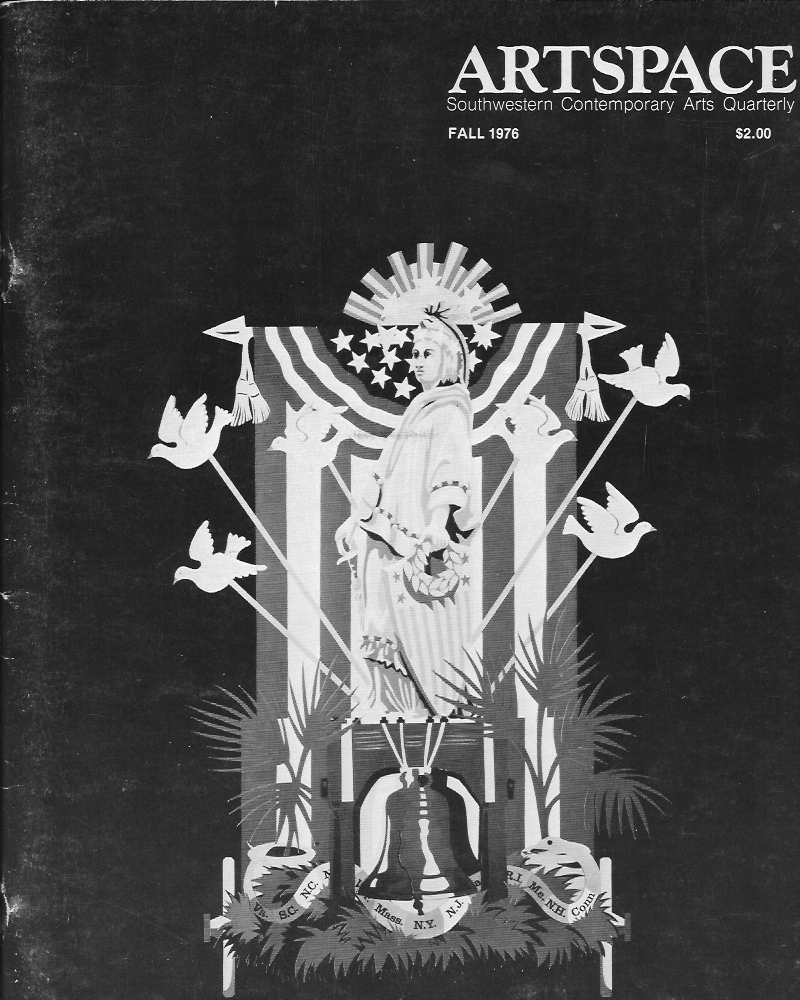
ARTSPACELarry Goodell: Co(s)mic Clown                                                           by Gus Blaisdell

Headdress of candle flames or engorged coxcombs; muscle-shirt rolling and bopping with bulges; and his cloth phallus thrust and wobbled by his raunchy hunching hips, Larry Goodell steps out upon the stage, possessing and invaded by his own poetry and paraphernalia. In the course of his caperings the stage becomes a charged piece of this whirling planet as he enacts, incarnates, and embodies in performance what poetry must have once been like before it was expurgated categorically into epic, which was tribal and gave to the bard shaman-like powers; into lyric, in which a single voice, sometimes masked, sometimes naked, hymned his friends, mourned them too, or celebrated Olympic as well as battlefield victories; and into tragedy, where the polis gathered to see itself confessed in the tension between the good sense of community and the overweening individual desire for knowledge or personal justice.

Goodell’s poetry is more ancient than these first, classic, Aristotelian resolutions. It is antediluvian, the seed and essence out of which these later categories will grow, twistedly—so twisted that the root and origin will be forgotten. And his poetry is also deeply comic, in a sense so attenuated as to be nearly unremembered: it is the work of the clown of power who ridicules as he celebrates the absurdities of being and existence, who probes Dasein, if you’ll permit that lugging term, with a hard-on, who stinkfingers existence, and who in his lightest and most powerful moments seduces the young woman, who is also being, into playing Doctor in the backrooms of bars like the now archaeological Thunderbird in Placitas, Goodell’s home. It was in the T-Bird that Goodell gave some of his most memorable performances to a wonderfully drugged and drunken audience willing to be gathered together by the powers of his poetry; making cohesive and momentarily coherent a disparate, desperate bunch of discrete creatures all tottering on the edges of every imaginable variety of unconsciousness, bloatedly expanded consciousness, and violence; and for an hour or so magnetizing the iron rings in them all, connecting himself with the ironic and co(s)mic sources of his own art, until not only the audience but the whole bar was, like the planet upon which it all spun, rocking and rolling through spaces public and private.

Obviously this is not the poetry of page and podium, book and lectern. The page is the speaking poet; the podia are quite literally the poet’s own dithyrambic feet seeking a measured rhythm in the midst of riot; and the book has become a score, the lectern tossed aside so that the poet, bedecked, can enter into the very medium in which he works: poesis dramatized. Here drama is a form of incarnation rather than performance, and it dilates the present to metaphysical proportions.

Antediluvian, I said, and by that I meant some prelapsarian time well before the Flood, when a being like Goodell could be both bird and snake, when these two powerful avatars shared a single phylum and before we separated them into specialized species, dividing essence as we do labor. The metamorphosis in Goodell’s works, speaking still in avatars, would be that one in which a snake sloughed his skin, shed scale for feather, and emerged surprised in radiant plumage readied for flight. In the peacock, for example, one can clearly see the snake. But in his plumage, in the hushed fanning out of his tail, one sees far beyond the peacock. As his eerie screams transform into the metaphysical, peacock becomes phoenix. Beyond the phoenix is the demigod, Quetzalcoatl, the plumed serpent. Beyond the demigod? Only the Sun itself.

Goodell is pre-Choric, a single manic creature wrestling with making sense out of being. His is a poet’s tongue, untwisting the commonplaces that tie it so that he may speak out clearly, the poem enveloping him; and as he speaks it out, dissolving the membrane, it becomes an action best represented by a breathless flame unraveling upwards, climbing higher for more air, more light, until the air thins and, subsiding, the consuming flame is extinguished. A priapic clown, shoving it up the world, he is exploring and inventing existence with hoots and a virile member. Locally, in the ancient Pueblos, this clown would be a mudhead, a creature still confused with the earth and blood into which he was thrown from the between piss and shit of his birth—anciently obscene, secular, profane as dirt, autochthonous. This is a creature like those wonderfully androgynous beings in Aristophanes’ contribution to The Symposium: creatures who sought each other, one always in need of the complement of the other, and who seemed to think they might put back together the sundered halves of the world by fucking each other crazily, restoring the anciently divided essence—whether of snake or bird, man or woman, being or nonbeing. Silenus Goodell! A creature who just can’t get enuf of it!

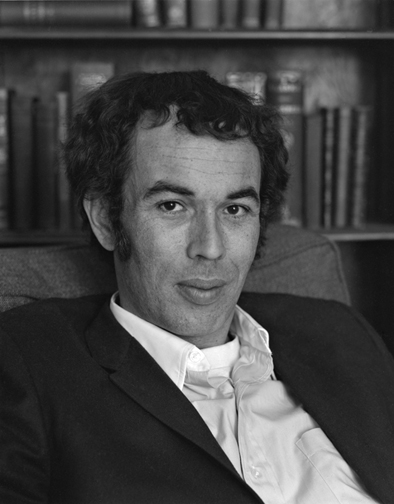
Blaisdell Jaffe duo0006

Poet as dancer, as chanter or singer who compels assent and prayer, he is the one who steps out of the poetic swamp, or slithers out, who rises above his own storming and confusion. As high as he can get on his oddly jointed limbs, he rests briefly above his work, his head coiled in feathers or lifted above rustling cool coils of scales. His body halts momentarily atop the locked joint of a single extended leg, the other tucked up below. Out of the nesting feathers of the body the head lifts, the eyes beady with concentration, the craning neck serpentine. Then the uplifted leg descends into the waters of the slough; the neck slides over and down, and as the talonful of rich muck is raised from the bottom, this creature either minutely inspects its contents, listing the details and making a poem, or else, dissatisfied with the results of his analysis, hurls this mud rich in restorative virtues into the roaring faces of his tipsy, toppling, soaring audience.

Truly to laugh with Goodell, to understand his Old Comedy, is to see revealed the weakening prehensile underpinnings of common sense; it is to see laid bare our uncommon prejudices and the contingency of what we commingle. On whirls the world: on the poet’s fingertip or, transformed by his rhythms, upon the nose of a seal—that sea lion of being that Hart Crane evoked from the beach once and for all, writing beyond himself: “Bequeath us to no earthly shore until / Is answered in the vortex of our grave / The seal’s wide spindrift gaze toward paradise.” This fleeting glance beyond is also the clown’s roaring, rapturous disillusionment with being.

I have used extended figures to explain the work of a man who is essentially a mixed metaphor. My purpose has been to evoke in the reader a feeling of Goodell. Yet the point implied throughout the preceding, and the point most worth making, is that Larry Goodell is a natural—a category that academe either explicitly denies, actively discourages, or has forgotten. Goodell is the poet fully gripped by song, the man who must dance, just as a goat must leap or make himself attractive to other goats by pissing down his throat. The natural is today treated as the aberrant, the freak, the perverted, and the consequence is that poetry now is only muttered up and printed on the page. Yet there is in art, as there is in sport and mathematics and chess, a prodigious category, full and exuberant and youthful. It is the category of the natural—swimmer, shortstop, painter, poet, or jazzman—and local examples include Goodell, Bill Pearlman, and Kelly Robertson. They are not shamans because they are unsponsored by a group and because they are not representative of a collective mind. They span only themselves. Free in their creations, which come from the isolate powers of their singular imaginations, they are their own centers, single points eccentric to academic circles. The sources and wellsprings and powers they display are not held in common. They are their talents themselves, all alone out there, dangerously ventured in their own originality.

Without this category of the natural, art of any kind is impossible. Because? Because against what academe teaches, theory only succeeds art—in a quiet, active meditation on work done by oneself and others. And art, if it is genuine, is a response of the whole individual to being-in-the-world, and it is not, not primarily anyway, the dramatic solution to an anteriorily posed critical problem. Having chosen not to deal with the natural, not to groom or train or nurture it, academe is left with only its own accomplishments—the brilliant but gelid genres of the modernist novel and poem, achievements somehow against the grain—and that turgid confusion of filched formica laurels, an arbitrary criticism that seeks to usurp and absorb its object and thereby, by digestion, to gain autonomy. But food digested, though it nourishes, turns to shit. –Well, but doesn’t everything? Ultimately, I mean. If you don’t know the answer to that one, you’d better keep on reading. (The proper question is not what survives but rather what does not turn to shit.)

Insofar as Goodell’s work is not academic neither is it part of the current late modernist movement of conceptual or performance art. Performance art is reactionary and self-conscious and offers its antics as a solution to a critical problem. Performance art is a dramatic response to what the performer believes cannot any longer be done in painting or sculpture. It is hysteria caught up and wedged between the slowly contracting walls of the two-dimensional and the three. In Michael Fried’s term it is theatrical—a bedecking of despair in which the performer simultaneously mocks himself and his work in the hopes that his ridiculed audience’s reactions to his own display of failure will, in complicity, acknowledge that to fail is really to achieve. It is as if Hemingway’s hideously painful gut-shot hyena in Green Hills of Africa were performing his death in order to win his killer’s approval. The shortest version of all this is the unexamined axiom of much bad modernist thought: that a vanguard precondition on having a subject is to declare the impossibility of a subject matter to be your subject matter. Yes, if you are Mallarmé, Bird or Trane, or Creeley. Otherwise the result is John Ashbery, a latter-day reincarnation of Wallace Stevens’ “muttering king,” who maunders among the shivering hinds of his verse like Elliot Gould’s overly murmurous, throwaway Philip Marlowe in Altman’s The Long Goodbye—an endless investigation of the erosion of imitative form by what it imitates.

Though natural, what is superb about Goodell’s enactments is that his is a naturalness re-achieved and against odds. His achievement of Old Comedy occurs in his unabashed willingness to say what comes to mind and, while avoiding the theatrical, to become, if needs be and the world demands it, the mouthpiece of ventriloquil being—by turns dapper Charlie McCarthy or bumpkin Mortimer Snerd—where a burp can become oracle, a Delphic choking or gargle, and a pratfall can jar loose the world. Goodell’s achievement gives credence to the comic’s ancient retort to How do you do it?—I just make it up as I go along. (And I am always going along!)

Certainly the priest’s vestments are nothing more than one resolution of the clown’s motley—just as the arithmetical norm called meter, the justice of the written poem, is merely a resolution of the poet’s own heartbeat in his jarred-loose response to an outtakilter world. A commodious vicus of recirculation: the poet in flight, or meditating, thinking down into the scales and pinions of himself, coiled to fly or strike or struggle. And once the recirculation begins within him and then passes to the audience, the measures of the poet keeping it all balanced just this side of frenzy—well, then the line comes inevitably to mind, filling something like a mind now held in common: “The light foot hears and the brightness begins.” (The line is a whole poem, Robert Duncan meditating on Pindar.)

I’ll close my prosaic anacreontic with a reminder in the inspired words of Stanley Cavell’s The World Viewed:

For poetry is so out of the ordinary that it could not appear unless the world itself wished for it. Not alone the poetry of poetry, but the poetry of prose—whenever the time of saying and the time of meaning are synchronized.”

[This essay appeared in the inaugural issue of ARTSPACE: Southwestern Contemporary Arts Quarterly, volume 1, number 1, Fall 1976 (where, unfortunately, inexperience left it riddled with typographic errors).]

Invitation to a Ghost

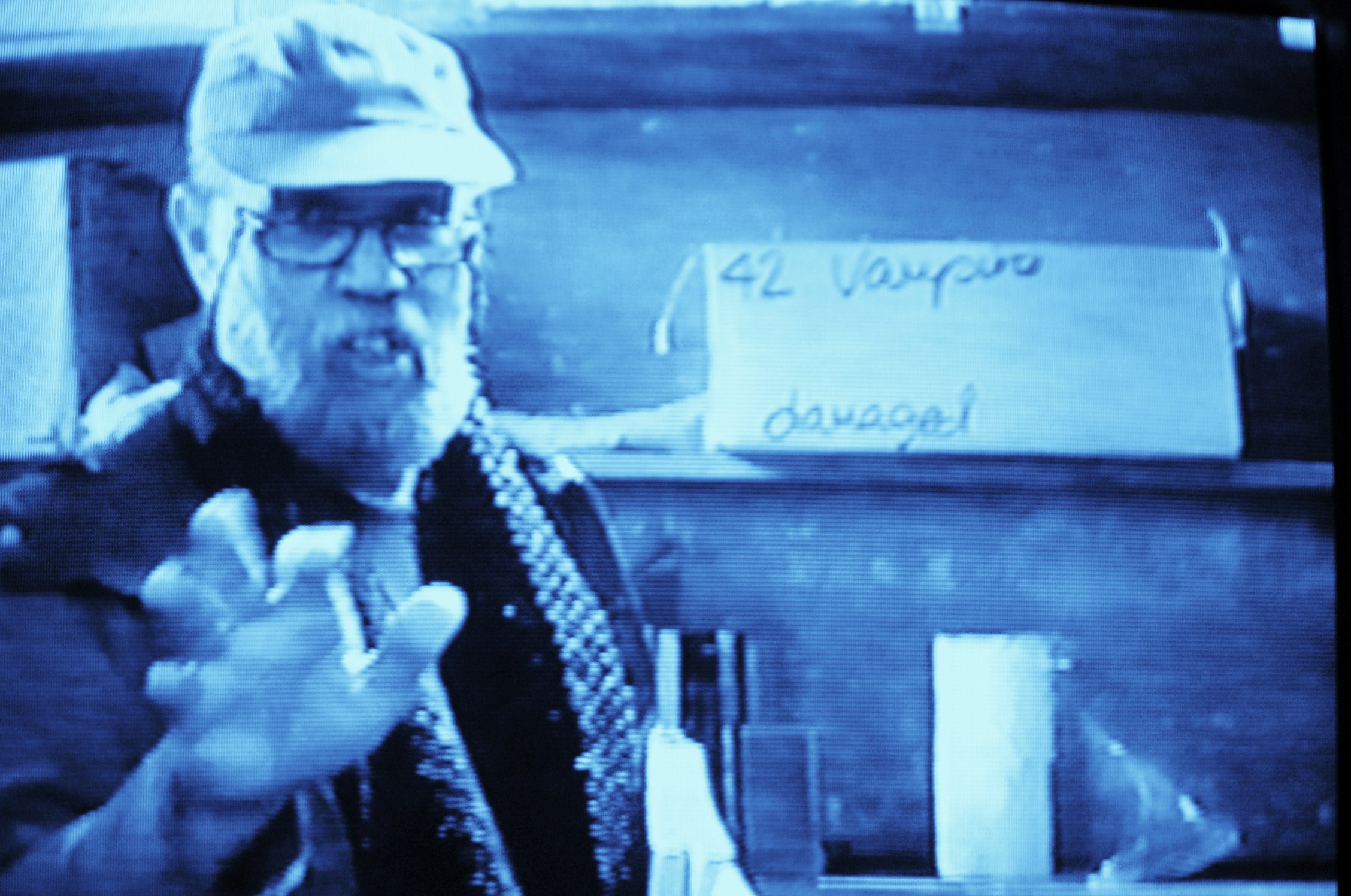
My Vampire

                            ©Nicole Blaisdell Ivey

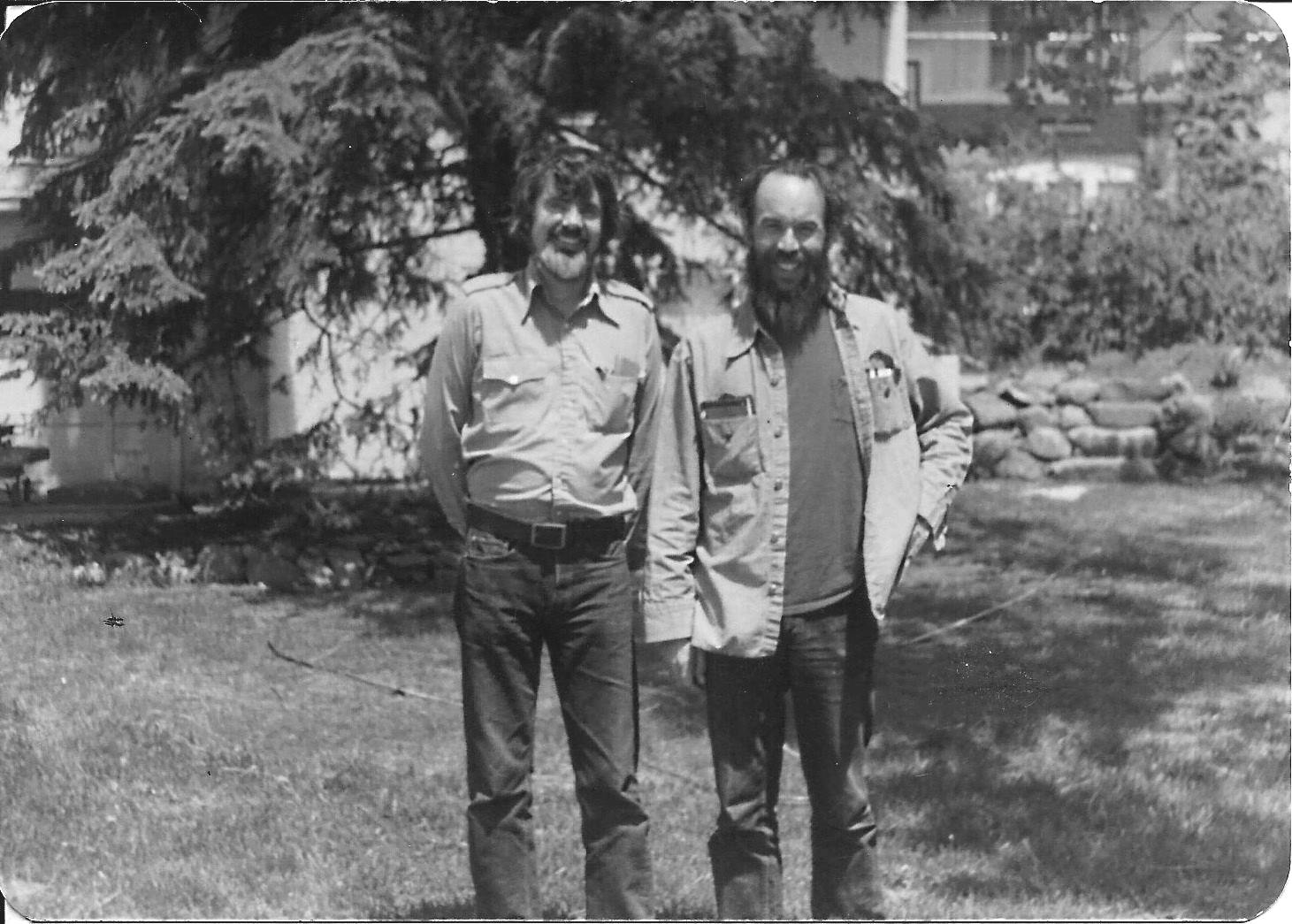
Ray Waddington and Gus Blaisdell 1973?

                     Ray Waddington and Gus Blaisdell 1976

Invitation to a Ghost

for Henri Coulette(1927-1988)

I ask you to come back now as you were in youth,

Confident, eager, and the silver brushed from your temples,

Let it be as though a man could go backwards through death,

Erasing the years that did not much count,

Or that added up perhaps to no more than a single brilliant

forenoon.

Sit with us. Let it be as it was in those days

When alcohol brought our tongues the first sweet foretaste of

oblivion.

And what should we speak of but verse? For who would speak of

such things now but among friends?

(A bad line, an atrocious line, could make you wince: we have all

seen it.)

I see you again turn toward the cold and battering sea.

Gull shadows darken the skylight; a wind keens among the chimney

pots;

Your hand trembles a little.

What year was that?

Correct me if I remember it badly,

But was there not a dream, sweet but also terrible,

In which Eurydice, strangely, preceded you?

And you followed, knowing exactly what to expect, and of course

she did turn.

Come back now and help me with these verses.

Whisper to me some beautiful secret that you remember from life.

Donald Justice

*Read by Raymond Waddington at Gus Blaisdell’s memorial celebration Feb 2005

Email from Ray in 2007

I can’t remember just when I first met Gus.  It wouldn’t have been 

our freshman year at Stanford (I was in a dorm on campus; he was in 

Stanford Village, Menlo Park).  Probably the second year, either 

through Vic Lovell or in Charles Allen’s American lit. class.  Allen 

was an eccentric (didn’t get promoted), whom we both liked; he gave 

Gus a magical stone for a (first) wedding present.  Curiously, 

although he hung out with creative writers, Gus didn’t take C.W. 

classes.  That year I lived in three different places, each with 

different people.  For the third year, fall quarter, I rented a 

cottage in the Los Altos hills and called Gus to see if he wanted to 

share.  I warned him that, since it was ten miles from campus, it 

wouldn’t work if he didn’t have a car.  Without missing a beat, he 

said, “That’s cool.  I’m buying a motorcycle.”  He lied, of course. 

The motorcycle never materialized, and in the end it didn’t work. 

For a while, it was fine.  We both were late sleepers and arrived at 

an elaborate wake-up system.  The alarm would go off; I would get up, 

put a record on the phonograph (Charlie Parker for noise or Mozart 

for annoyance) and go back to bed.  When the sound got to Gus, he 

would get up, swearing, and wake me up.  Eventually, we would go off 

in time for the 10:00 class.  Once we completely lost a day.  Went 

down for our Wednesday classes and found it was Thursday.  We 

explained it as a time warp, but more likely we just slept through. 

At this time, Gus’s particular enthusiasms were Catholic 

intellectualism (much to do about Etienne Gilson, Jacques Maritain, 

et al; and he talked me into taking a course on Christian 

Existentialism with him) and samurai movies.  He was taking beginning 

Japanese, and did a very impressive Toshiro Mifune imitation (he 

always was a great mimic).  I couldn’t believe it when he failed the 

course.  He was already keen on Yvor Winters (although the story of 

Winters rescuing him from expulsion is completely bogus); and we may 

have been the only two undergraduates in one of his classes.  I 

remember that he introduced me to Pat Madden (a Kentuckian who smoked 

cigars and sometimes wore white suits) and his bohemian set of 

hangers-on.  (Bohemian because this preceded the Beat era a few 

years)  Anyway, I got tired of having to wait around campus until Gus 

was ready to go home; but the deal-breaker was when he brought Phil 

Wilson, this weird ex-football player, in to live with us.  Wilson 

was broke, so paid no rent; big (he had been a guard) and took up a 

lot of space, just lying around in his fleece-lined sleeping bag. 

Sometimes his rich girl friend J.J. would show up, playing Lady 

Bountiful, to distribute food and clean house, but that was rare. 

So, at the end of the quarter, we agreed to go our separate ways, but 

stayed good friends.  Of course, we used each other: I always had 

transportation (he didn’t) and he had great entertainment value, both 

in himself and in the people he collected by charming them.  After 

that intense fall, I saw him more intermittently.  Although girls 

were amused by him, there was no girl friend until Carol Gay 

Eichelberger (she of the blank, Little Orphan Annie stare) for a 

while.  Then suddenly there was the really strange thing of the 

marriage.  Five minutes with Glennis and you knew it wasn’t going to 

work.  When I went off to graduate school in Texas and on to my first 

job in Kansas, I lost track of Gus.  But Charles Allen told me that 

he was managing a movie theatre in Craig, Colorado.  We were driving 

through, so stopped to see.  There was the movie theatre on the main 

street and through the window I saw Gus, with his feet on the desk, 

poking his finger through a bullet hole in a WWI German army helmet. 

A good reunion (met Sally, three little kids, of whom you must have 

been one), and we never lost touch again.  He would visit from time 

to time (in Madison WI with Felice, here in Davis); and I last saw 

him at the Yvor Winters Conference—a nice day together at a now 

unrecognizable Stanford.  Mainly we communicated by letters until he 

switched to Sunday morning phone calls.  I still miss them (as does 

Kathie).  I could give you more names conjured from the past (Mike 

Miller, mathematician and jazz pianist), funny stories (his method 

for getting Vic out of the bathtub), one-liners we always shared “I 

theenk it’s gonna be a heet, mon”), but maybe this is enough. I don’t 

know if it’s any help to you, but do let me know if you have 

questions or need follow-up.  Email or phone (530-662-0703) is fine. 

I work at home, so am usually around.  Best,

Ray

What Was Called “A Thought Echoed in Sight” Yvor Winters Centenary

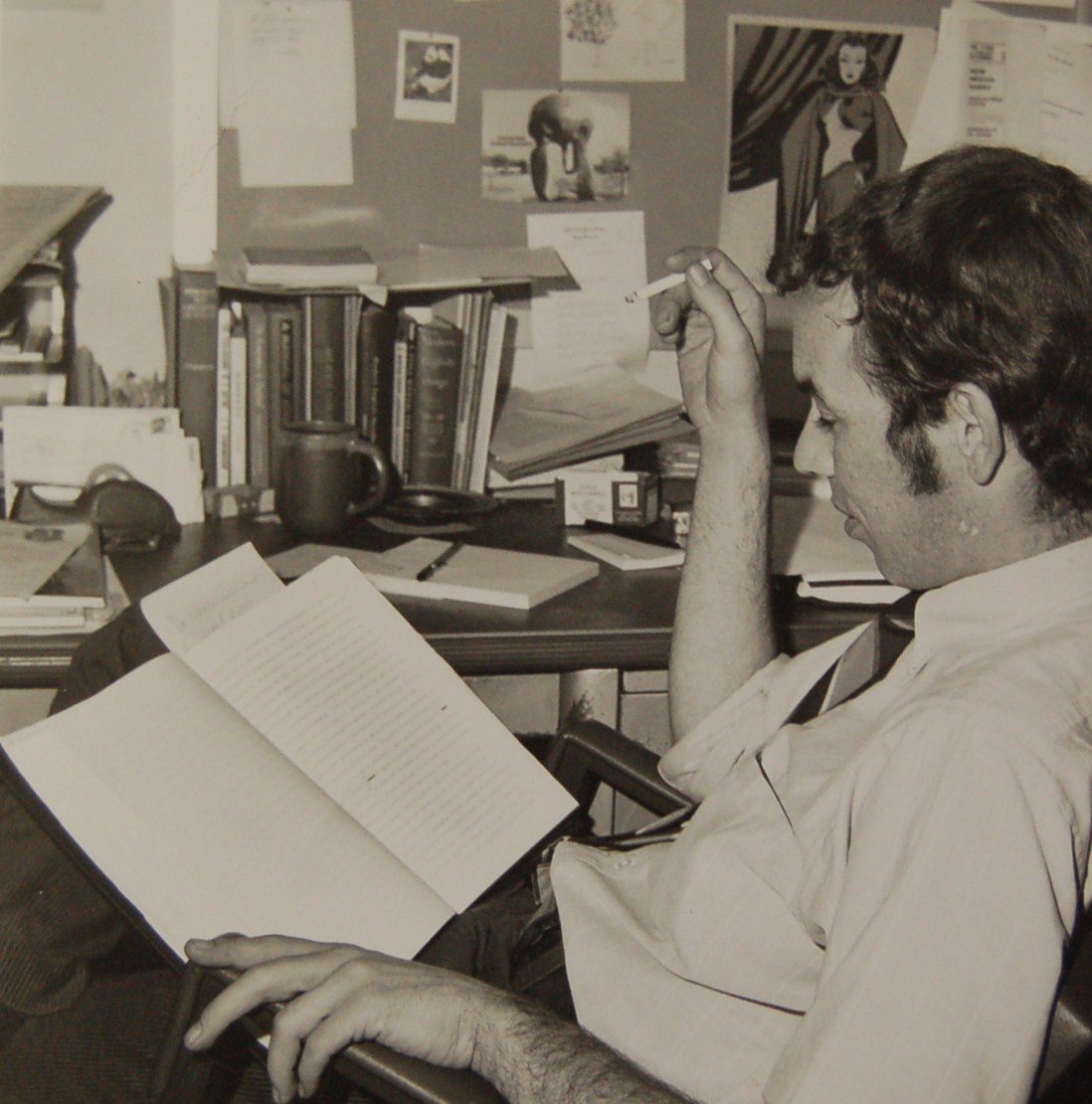
Gus at home

I recently came across Ken Fields fine essay, Winters’s Wild West, in the Los Angeles Review of Books –  http://lareviewofbooks.org/essay/winterss-wild-west/  – a tribute to his mentor and friend, the poet and critic, Yvor Winters. Ken’s essay is rich in history, detail, and poetry, and it paints a clear portrait of Winters in his place and time.  While reading it I was reminded of my late father. The bit below is taken from my chronology at the end of Gus Blaisdell Collected, published by University of New Mexico Press.                                               _____________________________

In November (1966), while at UNM Press, Gus receives a telegram saying that his publishing mentor and friend, Alan Swallow, has died of a heart attack at his typewriter. Gus writes a short tribute, “Bio of a Swallow,” and publishes it in the Winter issue of New Mexico Quarterly along with Alan’s autobiographical essay, “Story of a Publisher”.

In a letter, Gus writes, “I began commuting to Denver on weekends to help with running Swallow Press and it happened that my great teacher Yvor Winters’ last two books, Forms of Discovery and its companion anthology, Quest for Reality, were mine to design and edit.” In a letter to one of the lawyers during the chaos after Alan’s death, Winters writes that, “Gus Blaisdell undertook this job with no payment from the company and at considerable financial sacrifice to himself. He has done this out of admiration for Alan and myself and out of loyalty to Mae [Alan Swallow’s wife].” Gus also refused Winters’ offer of payment.

To Swallow’s wife Winter’s writes that “Alan was an odd genius. . .  . He had a gift which is restricted usually to good poets: He could recognize good writing and recognize it at once (he recognized the same gift in Gus, and so do I). It was this that made him a success as a publisher, this plus the energy of three bull-mastiffs. He was almost ready to take Gus on, before he died, as a junior partner; but he had been a lone wolf for so long that he couldn’t bring himself to it.”

______________________________________

In November of 2000, Ken Fields and committee invited Gus to be one of the speakers at the Symposium in honor of Yvor Winters’ Centenary at Stanford University. Yvor Winters was a mentor to Gus and helped him in many ways. Gus was happy to be invited for the symposium. He said it felt like coming full circle. One morning, as I sat sipping tea across from my father at his glass and steel dining room table, he handed me an early draft of his Winters address to read.  In a few weeks I would move from his beloved New Mexico to Montana. He had only recently started giving me his work-in-progress to read. He gave it to very few people. So, this was an occasion. And as I sat reading this address he’d written to honor his mentor, I cried. In the essay I learned much about my father that I’d never known. I cried because I was moving away from my intellectual touchstone, my mentor. I cried for reasons I did not fully understand. So, after recently reading Ken’s essay on Winters it sent me back to reread Gus’s tribute to Winters now published in GUS BLAISDELL Collected. When I came to Winters’ poem, “At the San Francisco Airport”, what struck me on this reading that hadn’t struck me so consciously before was that Winters’ was saying goodbye to his daughter, as my father, not a man known for outright expressions of love or emotion, by giving me this tribute, this poem to read at his dining room table those now many years ago, was saying goodbye to me.

  An Excerpt from Gus’s tribute

What Was Called
“A Thought Echoed in Sight”
An address to the symposium in honor of Yvor Winters’
Centenary, Stanford University, November 16–18, 2000

For several years I have started all my film classes at the University of New
Mexico with a screening of Chris Marker’s masterpiece La Jetée. The
movie is twenty-eight minutes long, made almost entirely of still images—
except for a single sequence of a woman, after love, sleeping in bed. She
opens her eyes and blinks three times directly at her (offscreen) beloved,
her watching beholder; at us. When this point arises in the conversation
with the class I read them the first of two poems, William Blake’s “Several
Questions Answered”:
What is it men in women do require?
The lineaments of Gratified Desire.
What is it women in men do require?
The lineaments of Gratified Desire.
I tell the class that “lineaments” for Blake are the boundaries of the soul,
and that “gratified,” as opposed to “satisfied,” desire requires a thankfulness,
a thoughtfulness of two, and that it is genderless. My young are not
taught “corrosion and distrust”—and neither were Yvor Winters’ young.
[Stanley Cavell, in The Claim of Reason, offers this gloss on Blake’s rhyme:
“Here is a brave acceptance of the sufficiency of human finitude, an achievement
of the complete disappearance of its disappointment, in oneself and in
others, an acknowledgment of satisfaction and of reciprocity.”]

When the conversation has ended or the class is coming to an end I
read my second poem to them, Winters’ “At the San Francisco Airport.”
Sometimes I read it twice, particularly the last stanza in which Winters bids
farewell to his departing daughter:

This is the terminal, the break.
Beyond this point, on lines of air,
You take the way that you must take;
And I remain in light and stare—
In light, and nothing else, awake.

Some students always come up after class wanting to know more about
the poet who wrote the last poem. My several tattered paperbacks of the
Collected Poems testify to their avidity.
Awake and in light. Heraclitus said that “the waking have one and the
same world, but the sleeping turn aside each into a world of his own.” But
Arthur is awake and alone, his daughter speeding away “on lines of air,” on
her own separate course, leaving him to remain in light and awareness of
the terminal break.

The Intellectuals at Okie’s Bar

Gus Blaisdell NM 1969 ©Arthur Lazar

Gus 1969 © Arthur Lazar

The Intellectuals at Okie’s Bar                                                                                                 for Gus Blaisdell

They are lovers of their own distortions                                                                               who sit in such darkness    music                                                                                     steaming about them                                                                                                                                                     beer swelling                                                                                       their muscles / sense and temperance                                                                                   tortured into hours of speech                                                                                                 to dowse their minds’ reflection                                                                                                                                                                  Ocean at night                                                     leaps up in tongues of green illuminated                                                                                 spume    and dies on sand                                                                                                       A residual humor flaps its wings                                                                                             evacuates into air                                                                                                                                                     The bar is                                                                                       headquarters for difficult gymnastics

There is nothing outside but stars                                                                                       and a sliced moon    cold now in Novermber that                                                                     arrogant Heaven peopled by the dead                                                                               Cars wearing holsters cruise                                                                                                   the boulevard                                                                                                                                                      at one with those harmonious                                                                         seasons and cycles to which                                                                                                   the balls of drunks aspire:                                                                                                                                                        to be contained                                                                           in Purpose     molten fluid pouring                                                                                 through strict cylinders                                                                                                                                                        to arrive at                                                                                       the laurel bush at last     completely relieved                                                                         done with hessian duty      into the arms                                                                                 of a goddess more woman than ghost

We are not the mob that coils                                                                                           around Fortune’s rim     Snake eyes                                                                                     inhabit our bones                                                                                                                                                             seeing fumes                                                                             canopy all gay processions (prophesy also                                                                         the pit where brains are buried)                                                                                                                                                      so we refuse                                                                       to march                                                                                                                                                         hippity-hop through Hell instead                                                                       our toes quick                                                                                                                                                           as red coals                                                                                             spend our laughter in heads of foam                                                                               matching the need for                                                                                                                                                                    bright occasions

Gene Frumkin (1928-2007)                                                                                                  from Clouds and Red Earth     Swallow Press

***First published in The Only Journal of the Tibetan Kite Society, 1969                                    edited by Howard McCord , The Tribal Press

Ken Fields poem for Gus

Gussy Gus
Albuquerque, NM

“Earth angel, earth angel, the one I adore”
–The Penguins

Ten months after your death I got the news.
All that time you were still alive.  Each week
I thought of you or told a Blaisdell story,
The way I saw you first, at my front door,
Six hours late, the middle of the night, festooned
With leaves in your hair from the back yards you’d crashed through
As curly haired as Bacchus and as stoned:
“Your neighbors don’t know you, man”—you kept shouting,
“Professor Fields, goddamn it.”  The next three days
We talked and drank around the clock, the only
Trace of that conviviality, the phrase
“Far fuckin’ out!”  We said it a thousand times,
Late sixties eloquence, we never looked back.
We burned our lives to the rail, in a few years,
You sobered up and in a few more, me too.
From then on we remembered what we said.

You got to Stanford through a pachuco gang
In San Diego, tattoos on the backs of your fingers.
Arrested for stealing a book, you finished high school
In a bad boys joint run by the nuns.  The bookseller
(Later your trade) thought about what you’d done—
He’d never had a thug steal Wallace Stevens,
So he sent you all the Stevens in his store
And In Defense of Reason, strange remorse.
This Winters is smart, you said.  You came to Stanford
Where Uncle Lumpy, as you called him, loved you.
Your master and mine, he called you his wild boy.
One day the dean of men confronted you.
He’d just found out about your tattoos.  “This school
Is a gentleman’s school, and I expect you to act
Like one, at least, and not come back next term.
We’ve never had anyone like you.”  When you told Winters,
He stood up, pushing his chair into the wall,
And stumped across the quad.  “I never knew
What he said to the dean.”  Hell, you know what he said,
“This boy is ten times smarter than you.  He stays”

You only taught the best:  Mrs. Bridge,
Basho’s Narrow Road, Kurosawa,
Chris Marker and Descartes’ Meditations:
“Wrong in every one of them, but read them
Like a French New Novel, narrated by a man
Trying to keep from going mad, and failing.”
You were my only intellectual.
Your charm,
Your beautifully vulgar equanimity,
Brought learning to the table and the street,
“Where the rubber meets the chode,” I hear you laugh,
The rude road Strode rode.  In that quick riff
You’d hear John Ford, Woody, and Sonny Rollins,
And the Duke holding court at The Frontier,
The all-night diner where you said good night.
When you described a round bed with a bedspread
Printed with a target—“it was like ground zero
At a fuckathon”—my wife fell in love with you,
“The funniest man alive.”  And you still are.

“Not too many words between myself
And the world outside,” you wrote.
Well, more than you let on.  A single room
Is overflowing with them, “Some white puff
Just beyond our mouth.”  I want to phone you
When a doctor tells me of a patient complaining
Of fireballs in her universe, another
Suffering immaculate degeneration,
And a man controlling his rage by taking something
He called Hold Off.  But no one’s home.
Gus,
Fireball, immaculate degenerate, you hold off,
You’re somewhere out there, as they say at Acoma
(Simon Ortiz recalls you at Okie Joe’s),
You’re somewhere out there, Gus, or as you’d say it,
(Corazon, baby) you are far fuckin’ out.

Ken Fields

I KNOW A MAN

In 2002, a year before his death, Gus wrote the bio below to accompany his poems included in  IN COMPANY: an anthology of New Mexico Poets after 1960

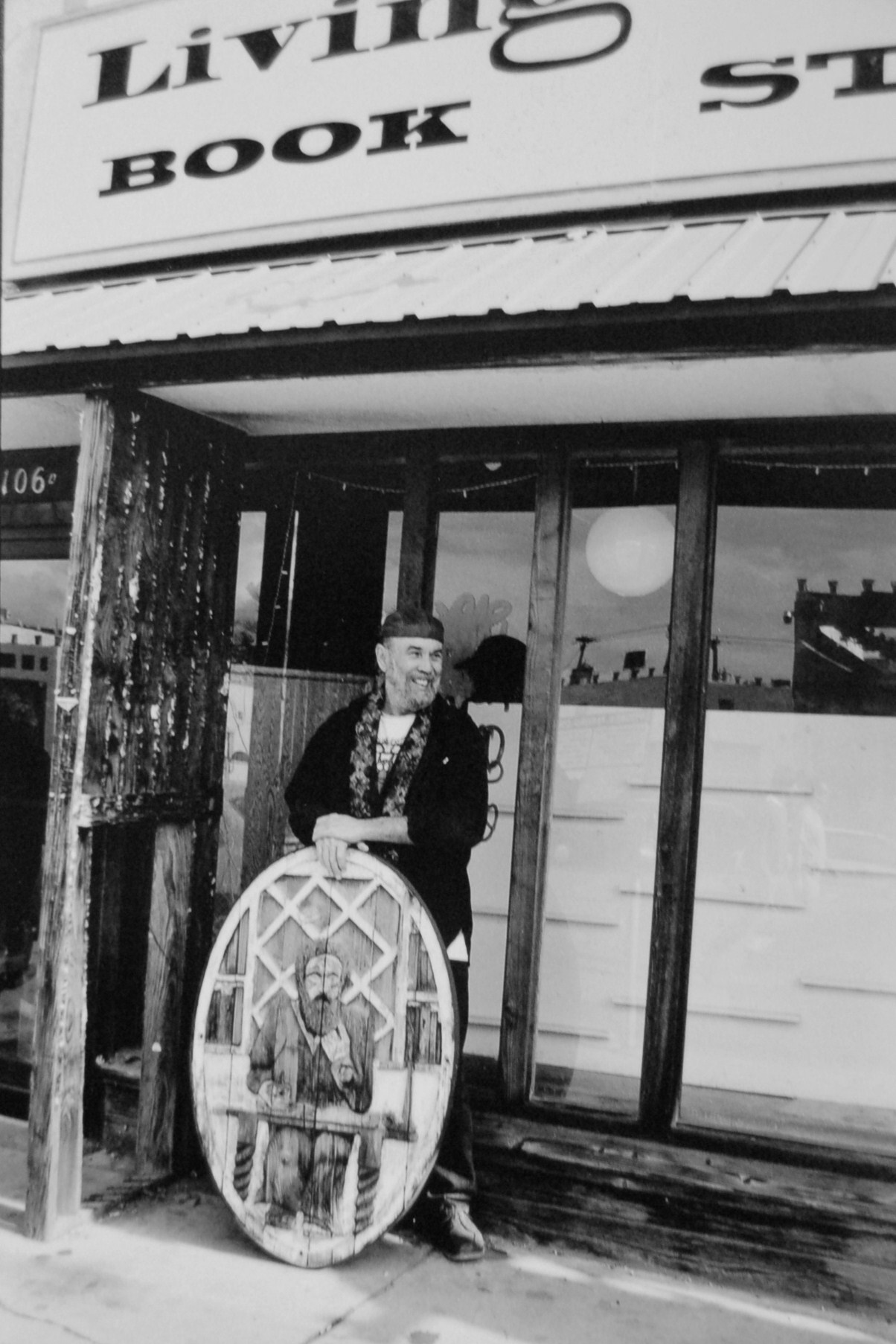
                                                                                      photo by Nicole Blaisdell Ivey

Gus Blaisdell for twenty-seven years ran an “alternative to an absence,” the Living Batch Bookstore, always close to the Frontier Restaurant. He continues to teach film at the University of New Mexico. He runs a small press, Living Batch Books , that continues to present his alternative to absences. A special line of his books is called Drive, He Said, after Creeley’s poem “I Know A Man.”

Message from Momaday

                          A note from Pulitzer prize-winning author, N. Scott Momaday, discussing the GUS BLAISDELL COLLECTED book (Gus was UNM Press editor on Momaday’s second book, The Way to Rainy Mountain, published by UNM press).

Dear Nicole,The book is a clear mirror of the man. It is beautiful and moving. Gus and I made a legendary journey to Rainy Mountain in the hard weather that shapes mind and memory. It was a quest, a journey eminently worth making.With deepest thanks.Scott


In Gus’s  “Holygraph” book (a blank dummy book for Ivor Winters’s Forms of Discovery run, filled with friends poems, drawings, autographs and insights) 

Scott writes,

“Dear Veering,
It has been good to be
with you on the way to Rainy
Mountain. One day you must
go to the cemetery there, to
see the gravestones of some of
these red people you must at
times feel that you know.
And I hope that the
weather is particularly hard
on that occasion.


N Scott Momaday
Christmas Eve 1968
"


Gus writes,


"On an Inscription in my Holygraph Book
for Scott.

We have/ been tog/ether/ now these/ many/ months
each on his way to Rainy Mountain, a journey
taken in fact, in spirit, and imagination.
It is a labor of love without loss, finding
my way, finally, to that dark stone
that bears your grandmother’s name.

You wish me the hardest weather on my visit
Such weather is the weather of my spirit,
A semiarid terrain wild with winds, and,
At evening, reason’s rage and fury flaming,
When the wind blows and wind bells ring
Or the snow falls down and no bell rings."


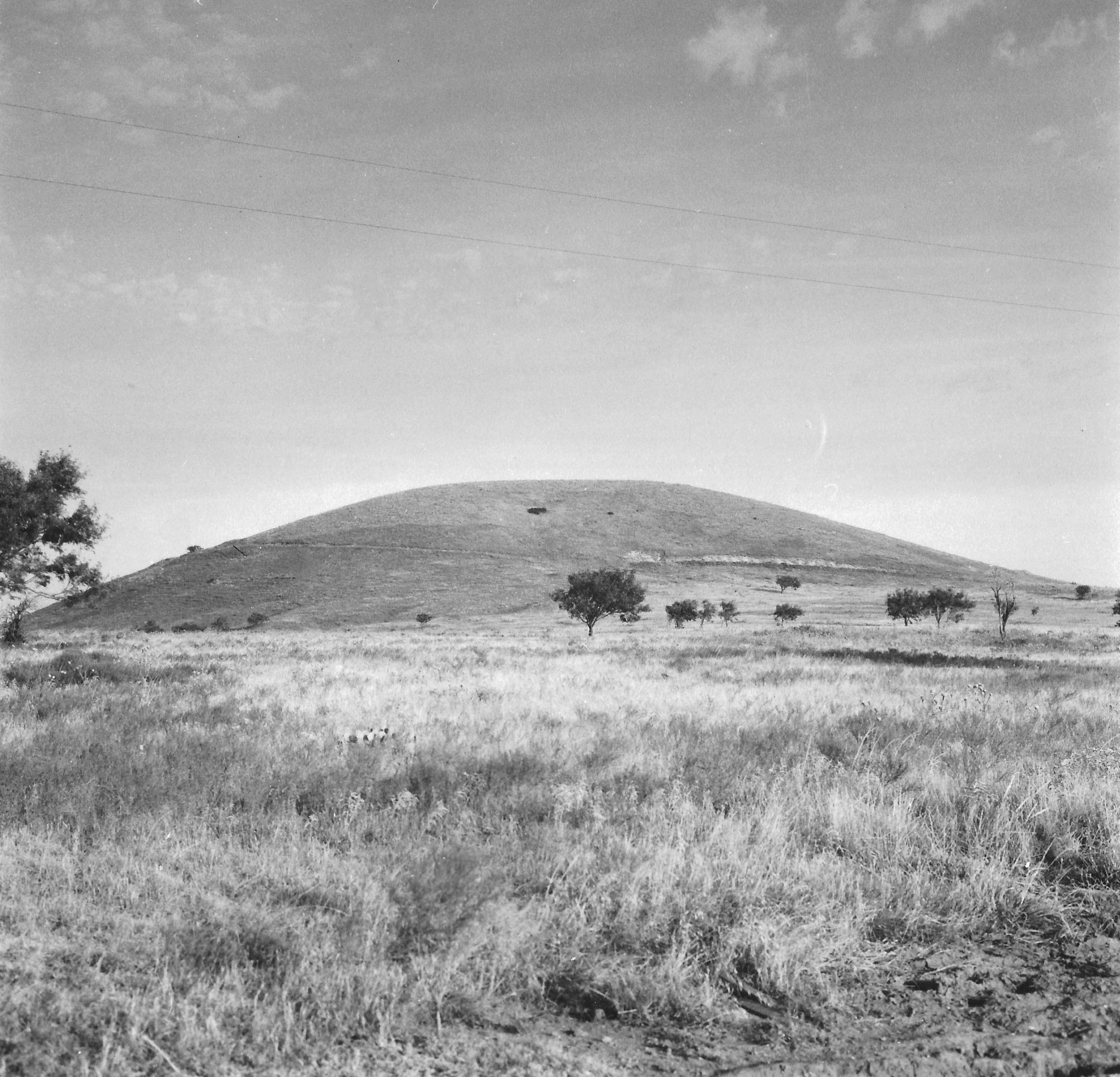
Rainy Mountain                   from the archive of Gus Blaisdell

N. Scott Momaday, Pulitzer-Winning Native American Novelist, Dies at 89

https://www.nytimes.com/2024/01/29/books/n-scott-momaday-dead.html