
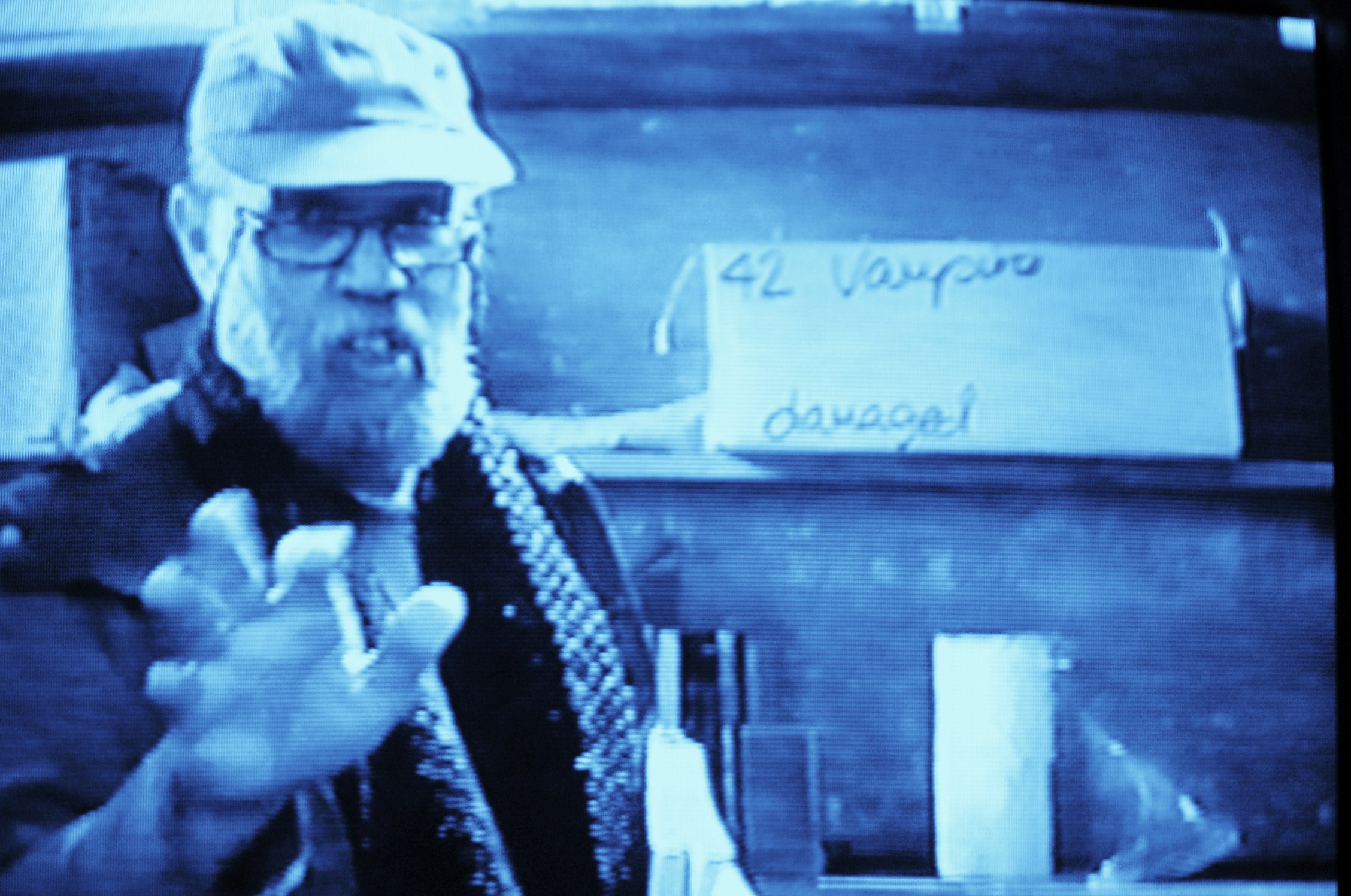
©Nicole Blaisdell Ivey
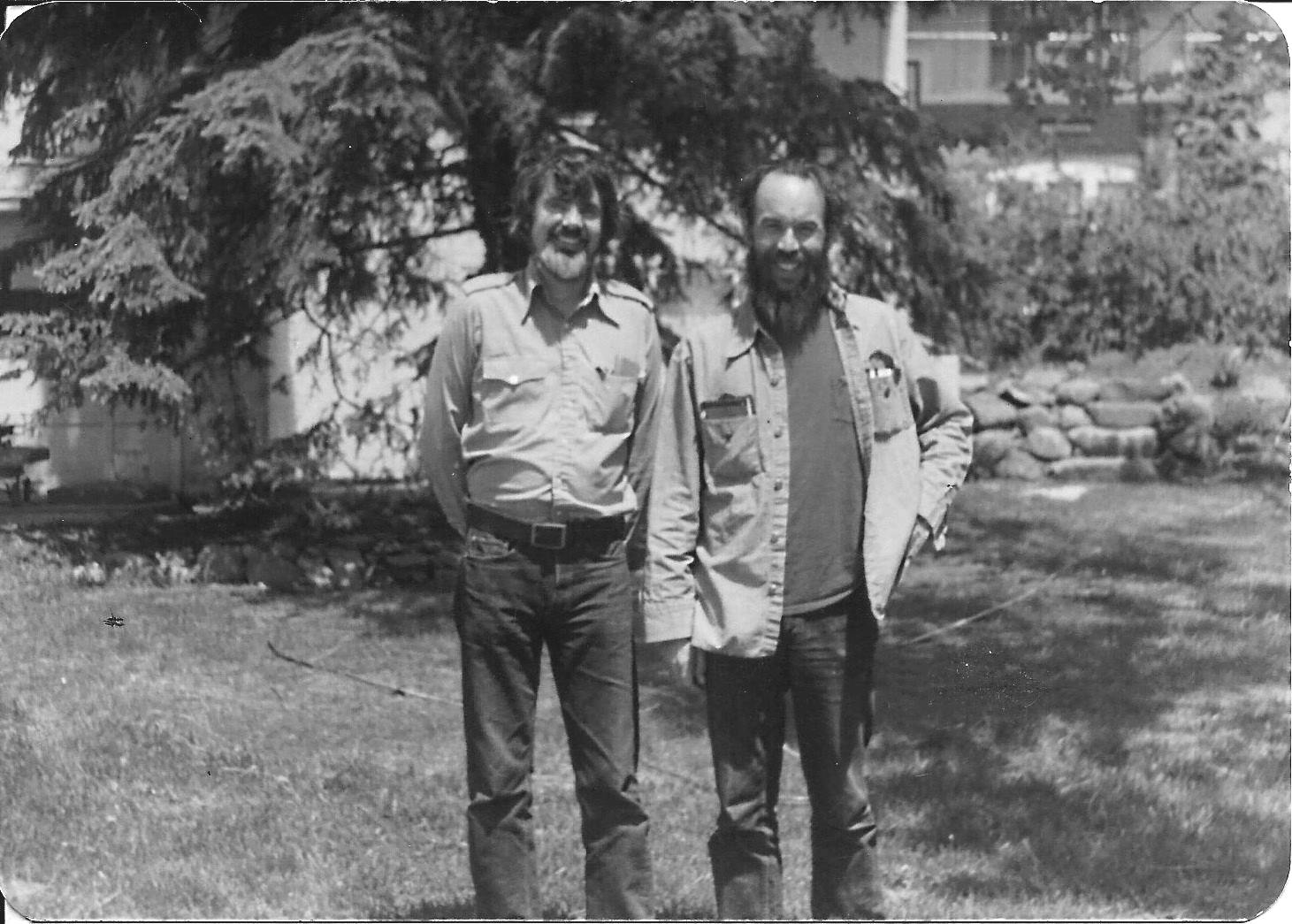
Ray Waddington and Gus Blaisdell 1976
Invitation to a Ghost
for Henri Coulette(1927-1988)
I ask you to come back now as you were in youth,
Confident, eager, and the silver brushed from your temples,
Let it be as though a man could go backwards through death,
Erasing the years that did not much count,
Or that added up perhaps to no more than a single brilliant
forenoon.
Sit with us. Let it be as it was in those days
When alcohol brought our tongues the first sweet foretaste of
oblivion.
And what should we speak of but verse? For who would speak of
such things now but among friends?
(A bad line, an atrocious line, could make you wince: we have all
seen it.)
I see you again turn toward the cold and battering sea.
Gull shadows darken the skylight; a wind keens among the chimney
pots;
Your hand trembles a little.
What year was that?
Correct me if I remember it badly,
But was there not a dream, sweet but also terrible,
In which Eurydice, strangely, preceded you?
And you followed, knowing exactly what to expect, and of course
she did turn.
Come back now and help me with these verses.
Whisper to me some beautiful secret that you remember from life.
Donald Justice
*Read by Raymond Waddington at Gus Blaisdell’s memorial celebration Feb 2005
Email from Ray in 2007
I can’t remember just when I first met Gus. It wouldn’t have been
our freshman year at Stanford (I was in a dorm on campus; he was in
Stanford Village, Menlo Park). Probably the second year, either
through Vic Lovell or in Charles Allen’s American lit. class. Allen
was an eccentric (didn’t get promoted), whom we both liked; he gave
Gus a magical stone for a (first) wedding present. Curiously,
although he hung out with creative writers, Gus didn’t take C.W.
classes. That year I lived in three different places, each with
different people. For the third year, fall quarter, I rented a
cottage in the Los Altos hills and called Gus to see if he wanted to
share. I warned him that, since it was ten miles from campus, it
wouldn’t work if he didn’t have a car. Without missing a beat, he
said, “That’s cool. I’m buying a motorcycle.” He lied, of course.
The motorcycle never materialized, and in the end it didn’t work.
For a while, it was fine. We both were late sleepers and arrived at
an elaborate wake-up system. The alarm would go off; I would get up,
put a record on the phonograph (Charlie Parker for noise or Mozart
for annoyance) and go back to bed. When the sound got to Gus, he
would get up, swearing, and wake me up. Eventually, we would go off
in time for the 10:00 class. Once we completely lost a day. Went
down for our Wednesday classes and found it was Thursday. We
explained it as a time warp, but more likely we just slept through.
At this time, Gus’s particular enthusiasms were Catholic
intellectualism (much to do about Etienne Gilson, Jacques Maritain,
et al; and he talked me into taking a course on Christian
Existentialism with him) and samurai movies. He was taking beginning
Japanese, and did a very impressive Toshiro Mifune imitation (he
always was a great mimic). I couldn’t believe it when he failed the
course. He was already keen on Yvor Winters (although the story of
Winters rescuing him from expulsion is completely bogus); and we may
have been the only two undergraduates in one of his classes. I
remember that he introduced me to Pat Madden (a Kentuckian who smoked
cigars and sometimes wore white suits) and his bohemian set of
hangers-on. (Bohemian because this preceded the Beat era a few
years) Anyway, I got tired of having to wait around campus until Gus
was ready to go home; but the deal-breaker was when he brought Phil
Wilson, this weird ex-football player, in to live with us. Wilson
was broke, so paid no rent; big (he had been a guard) and took up a
lot of space, just lying around in his fleece-lined sleeping bag.
Sometimes his rich girl friend J.J. would show up, playing Lady
Bountiful, to distribute food and clean house, but that was rare.
So, at the end of the quarter, we agreed to go our separate ways, but
stayed good friends. Of course, we used each other: I always had
transportation (he didn’t) and he had great entertainment value, both
in himself and in the people he collected by charming them. After
that intense fall, I saw him more intermittently. Although girls
were amused by him, there was no girl friend until Carol Gay
Eichelberger (she of the blank, Little Orphan Annie stare) for a
while. Then suddenly there was the really strange thing of the
marriage. Five minutes with Glennis and you knew it wasn’t going to
work. When I went off to graduate school in Texas and on to my first
job in Kansas, I lost track of Gus. But Charles Allen told me that
he was managing a movie theatre in Craig, Colorado. We were driving
through, so stopped to see. There was the movie theatre on the main
street and through the window I saw Gus, with his feet on the desk,
poking his finger through a bullet hole in a WWI German army helmet.
A good reunion (met Sally, three little kids, of whom you must have
been one), and we never lost touch again. He would visit from time
to time (in Madison WI with Felice, here in Davis); and I last saw
him at the Yvor Winters Conference—a nice day together at a now
unrecognizable Stanford. Mainly we communicated by letters until he
switched to Sunday morning phone calls. I still miss them (as does
Kathie). I could give you more names conjured from the past (Mike
Miller, mathematician and jazz pianist), funny stories (his method
for getting Vic out of the bathtub), one-liners we always shared “I
theenk it’s gonna be a heet, mon”), but maybe this is enough. I don’t
know if it’s any help to you, but do let me know if you have
questions or need follow-up. Email or phone (530-662-0703) is fine.
I work at home, so am usually around. Best,
Ray
 blaisdell Ivey collected