Finally, in the way of ” I’m finally getting a moment when I can
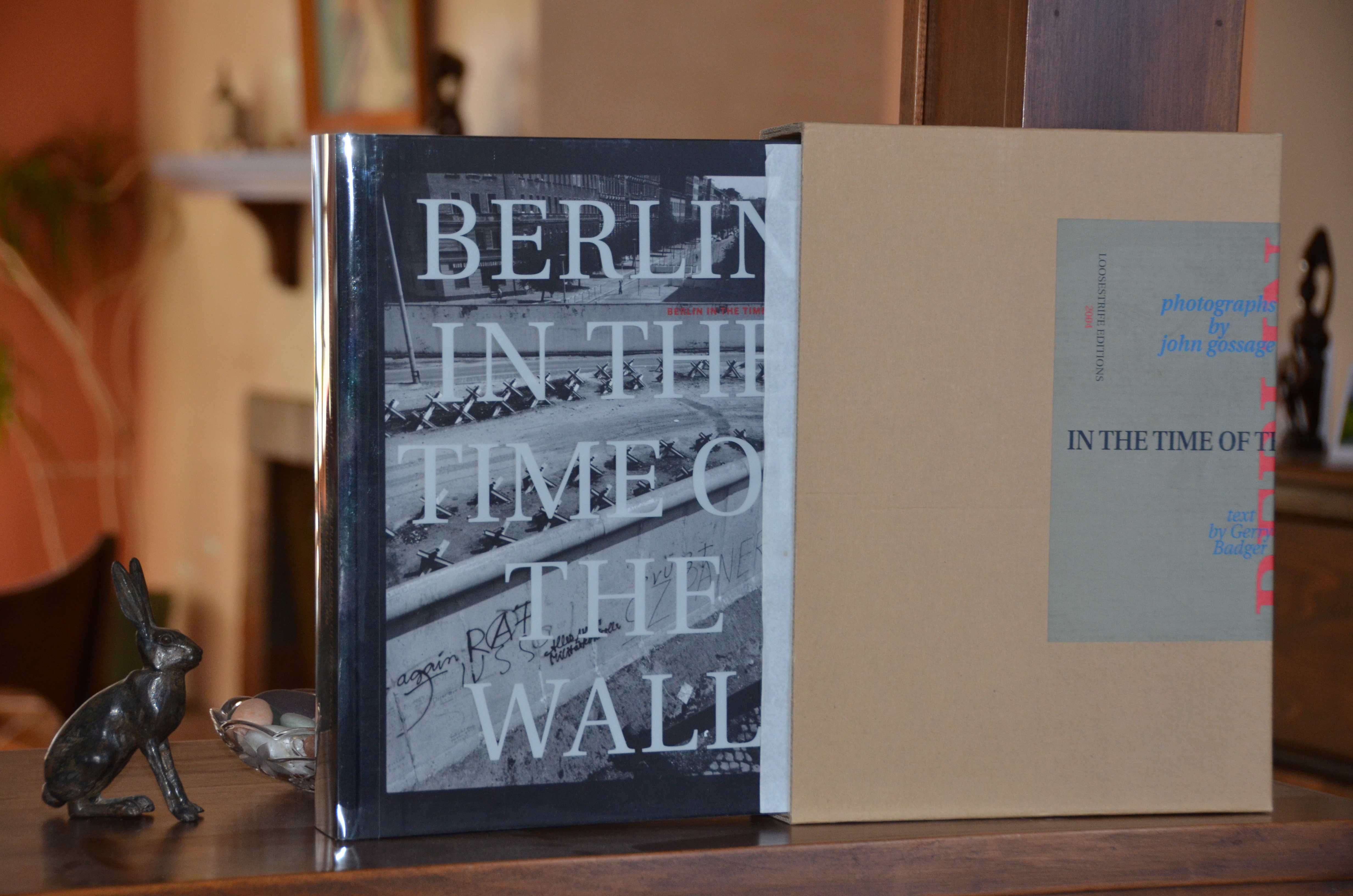
think”. I am awash with details for my next book “Berlin in the time of
the Wall”. I designed the book as well as made the photographs, so
every printing detail falls on me. It is something I’ve done before and
should expect, but it’s always something new ( ei. the slipcase won’t
hold the book correctly, since the book weights nine pounds and the
slipcase falls apart under that weight). But so much for complaints
about silly details. Thank you so much for the pictures of Gus and the
information about the service. I’m not a comfortable writer, as with
many photographers, but I would love to keep in touch with you…
… I have included the text for the Berlin book by Gerry Badger as
attachments to this since he quotes your dad a fair amount. I thought
some of it you might find of interest, as well as by sending it, it
makes me feel like I’ve sent you a long e-mail. Read what you find
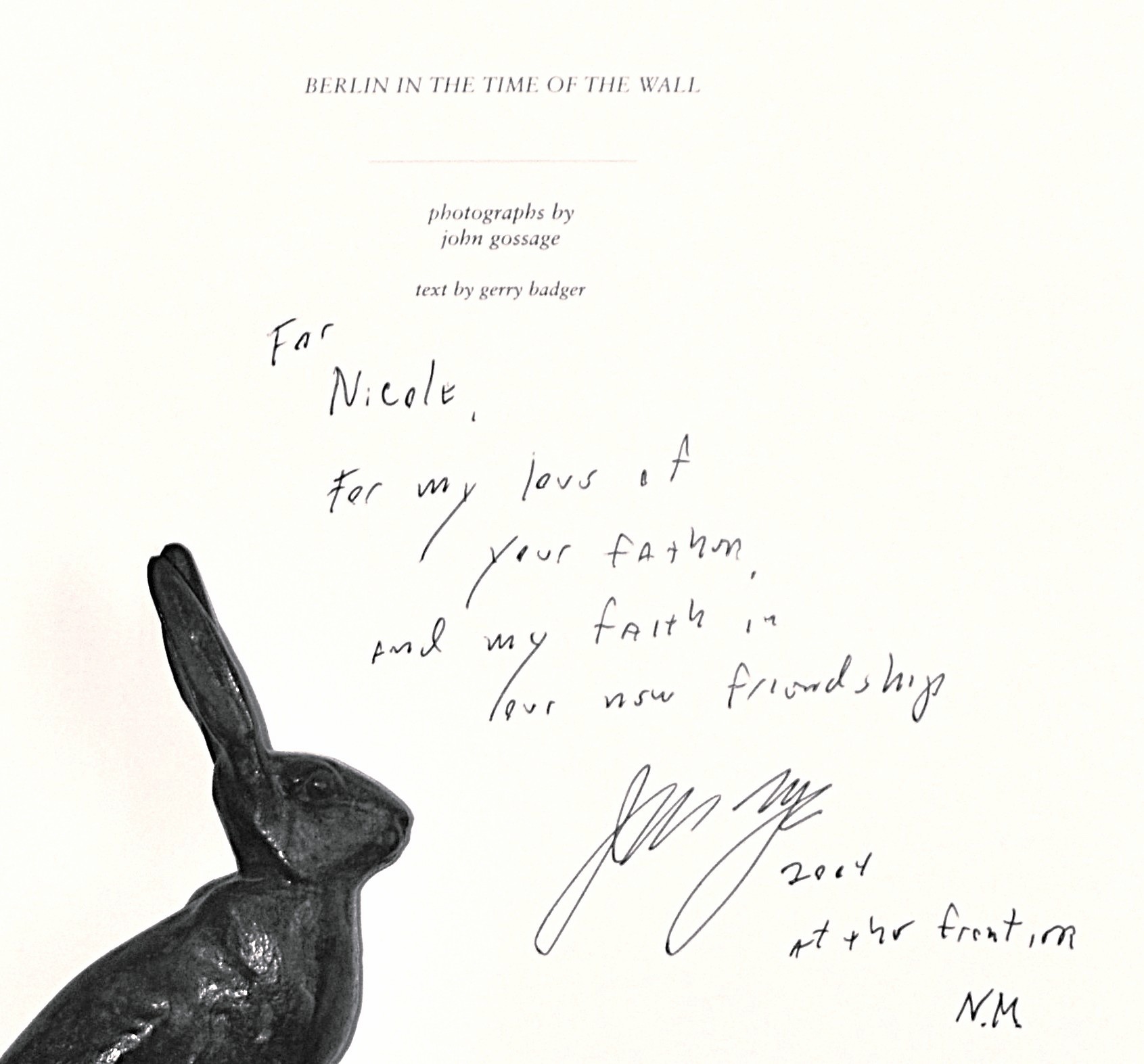
interesting and forget the rest. A book will be in the mail by the end
of the year.
All my Best,
John
John Gossage
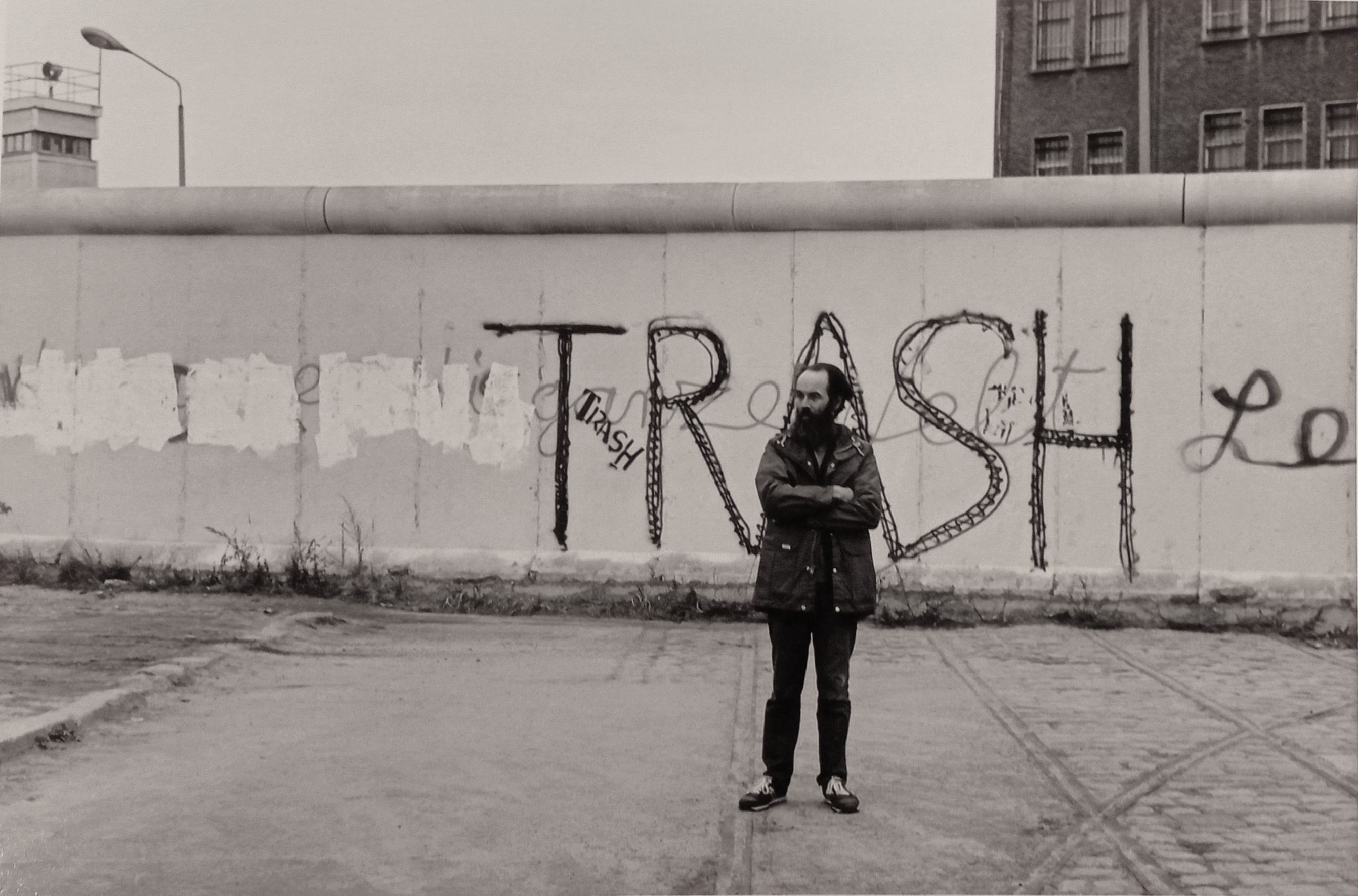
BLAISDELL, VOR DIE BERLINER MAUER — photograph by Lewis Baltz
Thirteen Ways of NOT Looking at a Gossage
in memory of Arnold Gassan
To use a horse to show that a horse is not a horse is not as good as
using a non-horse to show that a horse is not a horse.
–Chuang Tzu
John Gossage has asked me to write a few words about what his photographs are not. I have been in love with the negative since childhood. But what a photograph is not? Not identical with its subject; not a likeness of its subject; not a representation but a projection, because the original, as Cavell says, is as present as it ever was. In a photograph we see what is not present, the subject transformed in the medium of visible absence.
I particularly love negation used to isolate what a thing is, like the theologians’ via negativa. Attributes are taken away till the thing sought stands naked before you. Slightly obscene this long undressing of concepts and objects, it is like clearing out a bunch of weeds to get to a bare place. Gossage is seldom about clearing out. His photographs are often about a weedy and wasted jouissance. Whenever I look at a Gossage photograph one stanza from Wallace Stevens’ “Thirteen Ways of Looking at a Blackbird” comes to mind, the seventh:
O thin men of Haddam,
Why do you imagine golden birds?
Do you not see how the blackbird
Walks around the feet
Of the women about you?
Gossage is always about the luxuriance of what goes unnoticed, what goes unseen until his pictures call your attention to it. Stevens’ men of Haddam have grown thin imagining golden birds when at the feet of the women all around them they do not see either the blackbird walking or the women.
An exercise in subtraction. I will form pseudo-propositions with parentheses, negate them, and at the end, after the parens are closed, I attach the name of a major predecessor or contemporary of Gossage’s, artists with whom he shares a similarity but an even deeper difference.
NOT (atmospheric erosion like lichen clocks the head of Pan at Versailles; autumn leaves fallen on steps that descend semi-circularly to a circular landing and then continue their descent; the archaeology of streets and buildings presented after a terminal moraine has melted): Eugene Atget.
NOT (the American commonplace so quietly essential as to seem beyond the ability of photography or any other medium to capture, within the reach of nothing but admiration): Walker Evans.
NOT (the drama of the hard travellin’ road after Whitman and Kerouac, in outsider eyes where the lights are always going down, leaving only the ghostlighted stage of the photograph): Robert Frank.
NOT (still going on down, even Beat-ing it on down to its basic Beat-ness, the discovery of structure where mirrors crack the picture planes into what can be seen front and back and behind and beside, or a vegetal equivalent of an abstract-expressionist scrawl that blocks the picture surface–a genre of delirious possibility, but still anchored in the often rigid permanence of what looks like asides and throwaways): Lee Friedlander.
NOT (a gaze as steady as Buster Keaton’s wonders whether the industrial parks depicted manufacture pantyhose or megadeath; hip beyond irony or cool, where what passes for the so-called art world bleeds and leaks itself seamlessly into the so-called real world): Lewis Baltz.
NOT (a metropolis constructed by people for their discomfort, and which in turn refuses to reflect them in its curtain walls; eyes more alienated than Antonioni’s–eyes of an American veteran who returned with Vietnam locked in behind eyes that for years photographed without film or camera–eyes that stare at the traces of homelessness and the violence of wasted shooting sites where dolls’ heads hang for targets. Whether we edify or degrade we first create ruins, like Olympic sites once the games are gone and the local economy begins an unending hemorrhage): Anthony Hernandez.
NOT (the outrage rightly registered at the sight of a few trees that survive on the freeways of Los Angeles, or the stupefied faces of people on intimate terms with the thermonuclear unconscious of Colorado’s Rocky Flats): Robert Adams.
And certainly not the lush monumentality of nature declared only photographically: Ansel Adams. Nor the hermetic beauties of a Zen-inspired series of pictures, a variation of equivalences; but equivalent to–what?–in the world: Minor White.
Not far away, however. I haven’t lost Gossage; he’s been here all along. It’s just that it’s difficult to think negatively continuously (as Dylan sings, “A whole lot of nothing / Makes a man feel ill at ease”), to have cleared a space and to resist putting in it what belongs there. So I am going to give in just a little and transfer from absolute negation (since there is not much absolute negation, except for mathematical logic and Milton’s Satan who says, “I am the Spirit who Negates”) and indulge myself in some ‘not exactlys’ and ‘not quites’, and perhaps inch a little closer to what a Gossage photograph might be.
Not far away from Weegee’s crime scenes: with the bodies and the gawkers removed, all the stains in the streets and the curbside trash remains. Nature for Gossage is a place bristling with the attractive repulsion of armpits and crotches, and it is always alive, about to declare its animation, the shrubbery almost like David Lynch’s trees tossed in a night wind, violated by a motion characteristic of anxiety, dread, and agony. Premonition and foreboding settle in around a Gossage picture as atmospherically as Atget’s groundhogs in his parks.
I’ve come full circle, hinting what a Gossage photograph might be. Once, while making notes after years of reading Nietzsche, I abbreviated “the eternal recurrence of the same.” To my surprise the abbreviation read: “e.r.o.s.” Like Wallace Stevens in “Thirteen Ways of Looking at a Blackbird,” I collapse, loaf, and invite my soul, unable to decide which I prefer, inflections or innuendoes, “The blackbird whistling / Or just after.”
2002 — Gus Blaisdell
Originally published in John Gossage, The Romance Industry: Venezia / Marghera 1998, Tucson: Nazareli Press, 2002.
I recently found my high school textbook of Hamlet. A number of things about that edition surprised me, the first being that it was an interlinear edition, suggesting that we could not read Shakespeare without a trot or pony. I remembered such editions from my Latin classes, where of course they were forbidden, scorned as crutches, and used only surreptitiously outside of school. The second thing that caught my attention was that the fore-edge of my Hamlet was crudely marked in black ink with the school motto, as was the inside endpaper of the front cover: Tolle lege. Since magic markers did not exist in the early fifties I assume I’d used India ink, perhaps the stopper from the bottle, an ink our mothers used to identify our childhood underwear and clothing before sending us off to camp or, in my case, away to a military boarding school. (During the Second World War, I was known as “the little soldier,” as well as “the little man,” and all of our family of three were in uniform for the duration, my father a naval officer, my mother in the Red Cross, and myself in an itchy woolen miniature of West Point gray, impossible in the Southern California heat.) That same India ink we also used in gang initiations, for tattoos. Thirdly, across the free endpaper of my Hamlet sprawls the scrawl of my signature, blatantly less interested in legibility than in securing some adolescent dream of singularity, as the tattoos were supposed to have done at a slightly earlier period.
My high school, St. Augustine’s, was run by Augustinian priests who prided themselves on being one of the original teaching orders. It was an all boys’ school, the only one in a county boasting eight Catholic girls’ schools, where the nuns lectured the girls that they should only date Catholic boys. We used to taunt the most pious boys by wisecracking that, after all, Martin Luther had been an Augustinian, a joke not regarded as witty by the priests. The school motto, as I mentioned, was Tolle lege, Take it and read. The origin of this phrase marks one of the most remarkable moments in Augustine’s Confessions, his conversion in the garden in Milan. Sitting under a fig tree Augustine hears a child’s voice chanting as if in the singsong of some children’s game, Tolle lege. Tolle lege. He has been in an agony of desire, torn between two warring wills, those of his higher and lower natures. The book he has at hand in the garden is the Epistles of St. Paul. He seizes it and opens it at random, a sortilege of longing and agony. The book opens to Romans 13:13, 14: “Not in reveling and in drunkenness, not in lust and in wantonness, not in quarrels and in rivalries. Rather, arm yourselves with the Lord Jesus Christ; spend no more thought on nature and nature’s appetites.” Augustine continues, “I had no wish to read more and no need to do so. For in an instant, as I came to the end of the sentence, it was as though a light of confidence flooded into my heart and all the darkness of doubt was dispelled.” (Bk 8:12.) Sortilege, which means divination by using a book, was also practiced in the Roman Empire by consulting the Aeneid.
Augustine’s conversion was from the flesh to the spirit. The state of his agonized longing is structurally characteristic of adolescence. The state of my own adolescent longings was in the opposite directions. Such pieties and theological longings as I may have possessed disappeared (agonizingly, of course) when, at age nineteen, I began my first long term sexual intimacy. Nineteen was the age at which my namesake resolved, upon reading Cicero’s Hortensius, that philosophy would be his path. The antithesis of Romans 13 was my philosophical path: sex and drugs and jazz (rock-and-roll I fellow-traveled for the sex and drugs). So it was two summers after the summer of love, 1969, that I first met Jack Stauffacher. This brings me, less circuitously than might appear, to continuing my praise of Jack’s Greenwood Press, directly now rather than obliquely.
Gus Blaisdell editor at UNM Press
Unbeknownst to me, my eventually meeting Jack began three years earlier, when I was an editor at the University of New Mexico Press working on books and also on the New Mexico Quarterly. When I joined the press, its production was notoriously low, mainly because the director insisted on designing many of the books himself and was extremely slow. A university-wide study group concluded that the one thing the press needed above all else was a professional designer. So in 1966 the press hired Frank Mahood, a student of Jack’s at Carnegie Tech and later the designer at Syracuse. I remember the coincidence of looking through his portfolio and noticing that he had designed Ernest Bacon’s Notes on the Piano. Joseph Bacon, guitarist, lutanist, painter, and philosopher, had been a friend of mine since college, and I always took such coincidences as serendipitous. Joe has been a friend of Jack’s for some time. It is not so much that what goes around comes around as that things meant to be will connect.
When he arrived, the first book that Frank designed happened to be the first book I had edited for UNM Press. So it was here that I began to learn about the art of typography, here I first heard Jack’s name and learned how he taught Frank the use of Bodoni, the first name of a type that I ever heard. Prior to Frank’s tenure I knew nothing about typography.
On Thanksgiving Day 1966, Alan Swallow, whose books I had been distributing locally since moving to New Mexico, died at his typewriter in Denver. I began commuting to Denver on weekends to help with running Swallow Press, and it happened that my great teacher Yvor Winters’ last two books, Forms of Discovery and its companion anthology, Quest for Reality, were mine to design. I was thrilled; Frank, whose guidance I sought, was reluctant but helpful nonetheless. I learned about Gill faces for the first time, and got a firsthand acquaintance with Electra, which was the body type for New Mexico Quarterly, and Perpetua. It was in this period of enthusiasm that I first read Updike (D. B., not John). The last book I designed, and the only one for UNM Press, was N. Scott Momaday’s The Way to Rainy Mountain. The connections between all the dramatis personae in the little drama of Rainy Mountain–Swallow, Winters, Momaday, Mahood, Stauffacher, and me–is worth a digression, especially since I seem to recall once hearing that the essay is the art of controlled digression. The question is where to start disentangling the actors so they can be re-entangled anew.
Winters sent me a copy of The Reporter containing a memoir of Momaday’s of the same title as the book to be, a remembrance of his Kiowa heritage. The appended note from Winters stated that Momaday was the greatest poet in the language since, I suppose, Frederick Goddard Tuckerman, whose poems Momaday edited for a new edition in 1965, and he is the youngest poet included in Winters’ critical summa, Forms of Discovery. Winters also mentioned that New Mexico Quarterly had first published Scott’s early poetry and that Scott had a novel with Harpers, and that Swallow had rejected a poetry collection.
After reading Scott’s memoir and early poetry, and contacting his editor at Harper and Row, who chanced to be a college classmate, I wrote Scott suggesting he consider a book along the lines of his Kiowa memoir. He replied that a livre de luxe of further Rainy Mountain material was forthcoming, that he would send a copy along, and then, depending on what I thought of the new material, we could think about a book. I thought the additional material was as wonderful as the original. Scott put a manuscript together so well written that it needed no editing, and in accordance with the press rules, we submitted it to outside readers–anthropologists, alas. They determined it wasn’t anthropology and objected to its James Fenimore Cooper-like sentimentalities. Normally, this would have finished the book. But I was outraged at their imaginative insensitivity and their critical superciliousness, their willful proprietarian ignorance. So I decided to resubmit the manuscript to a new selection of outside readers–writers, this time, not anthropologists. Janet Lewis, Evan Connell, William Gass, William Eastlake, Paul Horgan, Wallace Stegner, Edward Abbey, and others responded at length to the literary masterpiece that Rainy Mountain is. Loaded for many bears with a lot of big guns, I took the book to committee where it passed unanimously.
Design was the next task, which I undertook enthusiastically under Frank Mahood’s tutelage. Optima had become a fashionable passion of mine and Frank guided me in the layout. Italics (or oblique) sections we set in type outside the printing plant at Joe Reay’s Typographic Service, the only fonts of Optima in the state. At this point Scott suggested his father, Al, a distinguished Kiowa artist, as illustrator. Frank decided the illustrations should be bled, printed without any boarder or frame on the entire page. We picked the cloth for the binding and Frank did the title page. I go into all this to correct the misattribution of the design to Bruce Gentry, who did only the layout of the dust jacket, from designs of Frank’s and mine. But Frank, working for a typographically ignorant commercial director, left in 1968. I followed in 1969, and when I saw finished copies of the book I was outraged at Gentry’s crediting himself with a design that was, beyond the wrapper, in no way his.
This was the summer, 1969, in which I first met Jack, who had left Stanford University Press under circumstances similar to Frank’s and my departures from UNM.
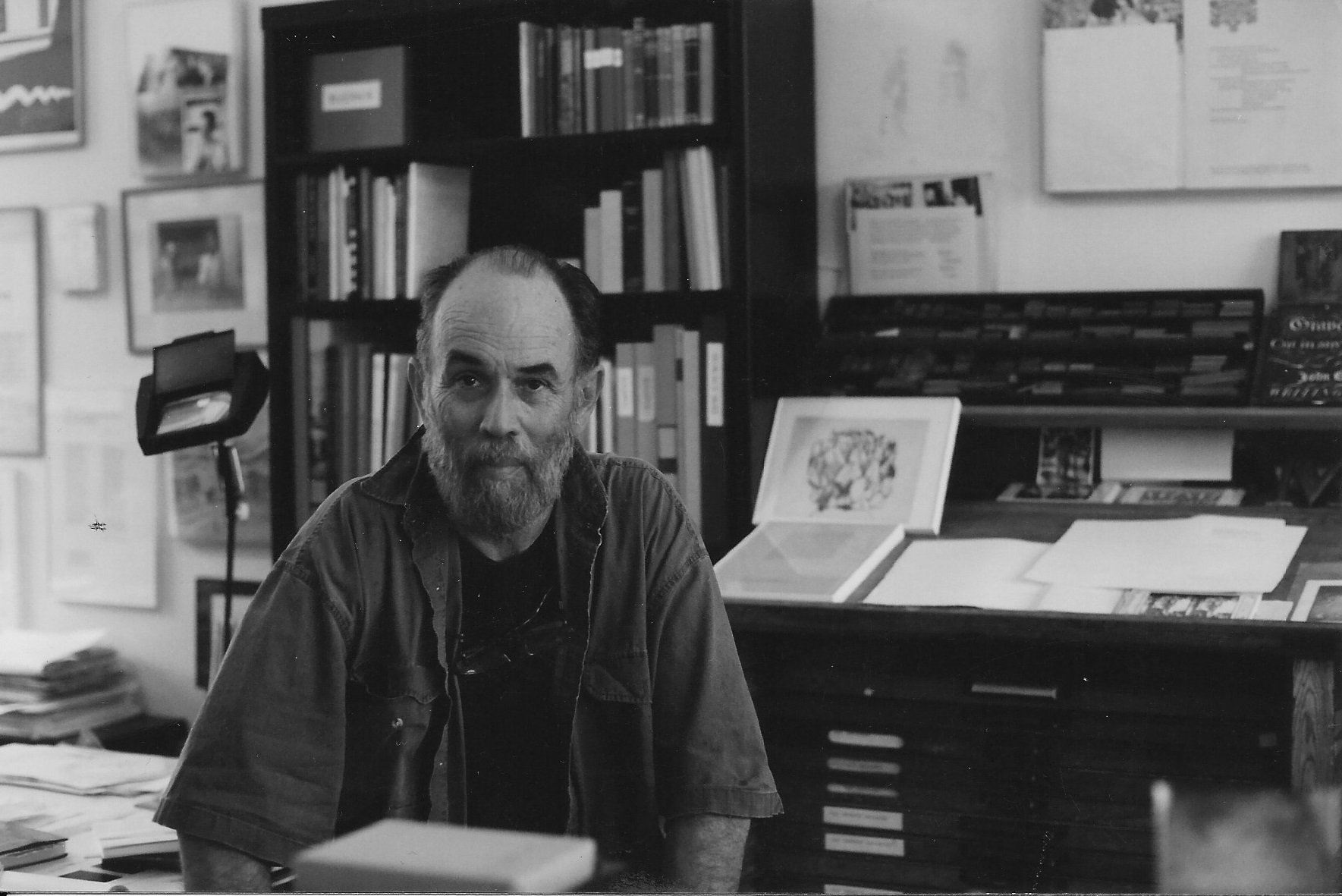
Gus at Jack Stauffacher’s Greenwood Press San Francisco 1986
1999
Published as “A Vigorous Lucidity” in A Typographic Journey: The History of the Greenwood Press and a Bibliography, 1934 – 2000, San Francisco, Book Club of California, 1999. This version is from an undated computer print-out manuscript inscribed with marker: “Stauffacher / Book Editing History.”
Robert Creeley reading at The Living Batch bookstore Albuquerque, New Mexico
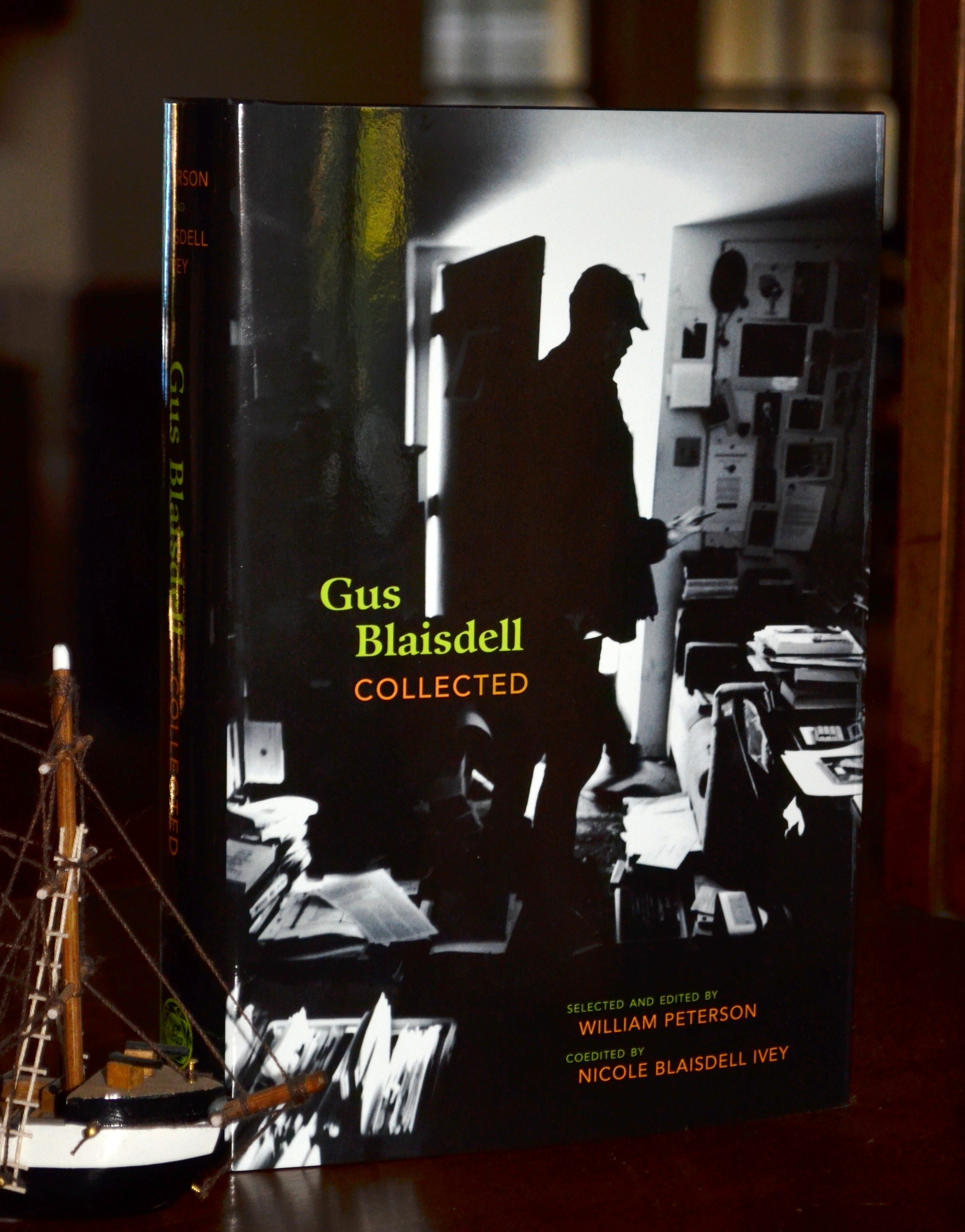
From the Editor’s Preface to Gus Blaisdell Collected
Darkness sur- / rounds us
I Know a Man
As I sd to my
friend, because I am
always talking, –John, I
sd which was not his
name, the darkness sur-
rounds us, what
can we do against
it, or else, shall we &
why not, buy a goddamn big car,
drive, he sd, for
christ’s sake, look
out where yr going.
–Robert Creeley
Gus had a special fondness for this poem by his longtime friend Robert Creeley. He took one of its key phrases for the name of one of his publishing imprints, drive he sd books. He also paid homage to Creeley’s poem at the close of the long essay “Buried Silk Exhumed.” There he presented an imaginary anecdote about two of his favorite jazz musicians, Thelonious Monk and Dizzy Gillespie, driving (presumably in a “goddamn big car,” top down, shades masking their eyes) along the California coast. “It’s always night,” Gus has Monk remark idly, gazing off to the shimmering afternoon horizon, “because it’s only light when the sun’s up.” To which he has Diz respond, “Monk, you are one deep cat.”
Gus, too, was a deep cat. And while he loved jokes, lively conversation, and tall tales with an intellectual spin, darkness, like Monk’s perpetual night, shadows much of the writing brought together in this book. It is the darkness of human finitude. While we hardly know what truly drives us, it’s a dread of darkness that jump-starts the helter-skelter getaway in Creeley’s poem, apprehension marked with that stammered line break voicing how darkness “sur- / rounds us.” Darkness, in Creeley’s rendering, hovers over us in ominous supremacy and encloses us within its limiting sphere, a nifty turn on Shakespeare’s “our little life is rounded with a sleep” that Gus surely admired.
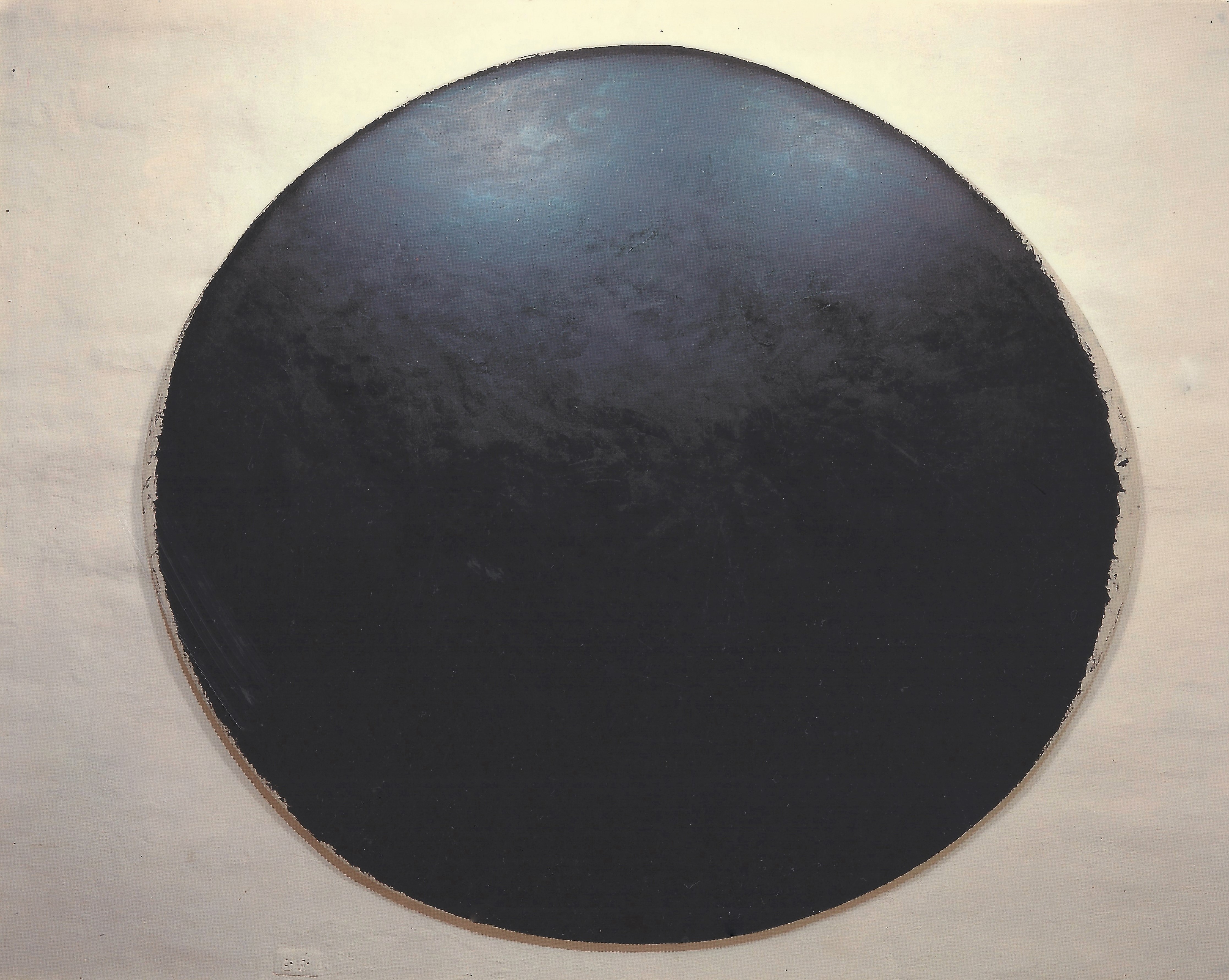
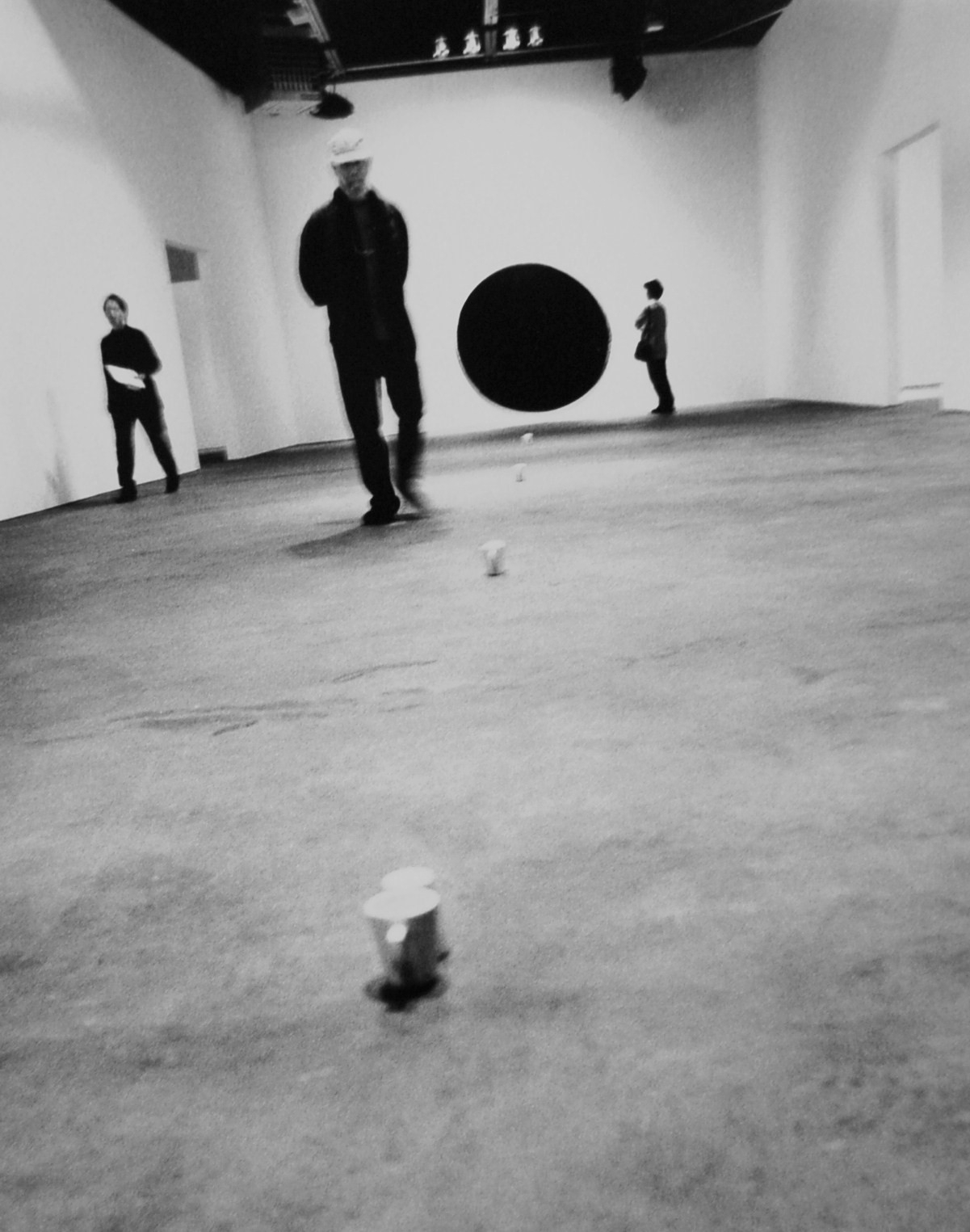
Like Creeley, Gus brought the instincts of a poet to his philosophical confrontations with darkness. In “Original Face,” an essay about a round, black, tondo-shaped painting by Allan Graham called Moon 2, Gus explores the darkness that precedes consciousness and is our constant companion. He quotes an ancient Zen koan, “Before your mother and father were born, what was your original face?”, to recall for us the darkness of unknowing out of which we have come, and to remind us that we must always look out from behind our own faces, remaining as dark to ourselves as the far side of the moon. Ultimately, self-knowledge, and the relationship of the self to the world, is the central issue addressed in these writings.
“Become the kind of person on whom nothing is lost.” Henry James’s advice to a young writer became a kind of mantra for Gus. It defined for him the task of the critic as well as the poet, and he felt it should be applied to everyday life. You have to observe closely and bring all that you know into your response. As a critic Gus assumes the role of an exemplary responder, showing what it’s like to attend to the work at hand. His essays frequently begin with a kind of preamble (before they take the mind for a walk), in which he tells of his difficulties in trying to come to terms with his topic, the struggle with the evolving hydra-headed implications that would occur to him as he tried to think about it conceptually and get his thoughts down on paper. “Original Face” is the most extraordinary response to a work of art that I have ever encountered. Gus simply presents himself to the work of art, confronts its singularity with his own, and engages with it as a fully embodied consciousness.
“Self-knowledge, no matter how fragmentary and tenuous,” Gus wrote in the 1960s, “is the right kind of knowledge, the dialogue between ourselves and ourselves and between ourselves and the external world.” No matter what the ostensible topic might be—movies, photographs, or the expressive qualities of various works of art, literature, or philosophy that he admired—Gus’s writing revolves around the quest for knowledge of the self and the search for understanding our human placement in the world.
There is a problem, however, at the very heart of the quest for self-knowledge. As Gus once observed about self-consciousness, “It’s interesting that the self, as a prefix, keeps its hyphen, never quite combining with the consciousness it engenders; no, that engenders it.” Consciousness of the self drops a shadow between the self and itself, just as it also intervenes between the self and the world. The black hole of solipsism is poised to suck us in, and the threat of skepticism, with its murky doubts and its despair of certainty (since our physical senses are notoriously untrustworthy and our knowledge of other minds always feels problematic), clouds our outlook on the world “out there.” Darkness “sur-rounds us” indeed.
“How does one get out of the monstrous enclosures of the egocentric self?” Gus asked, writing of his early interest in such philosophers as Descartes and Hume, who agonized over these issues. In a letter to Ross Feld he tells of his early “romance” with the mind/body dualism of Descartes: “I was in search of the idea which engendered the body in the world, as was he [Descartes]. His idea was God, one in which content leads to existence. But that doesn’t work for me. God, for me, is a name for the fruitfulness of our ignorance, a thinking in the dark that pushes us on, and on: a fruitful ignorance.”
So Gus’s God is associated with “a thinking in the dark that pushes us on.” According to Wittgenstein, a key philosopher in Gus’s development, “Thought does not strike us as mysterious while we are thinking, but only when we say, as it were retrospectively: ‘How was that possible?’ How was it possible for thought to deal with the very object itself? We feel as if by means of it we had caught reality in our net.” (Philosophical Investigations, I # 428) But the truth is that neither reality nor the thinking self can be so easily caught. Our only net is language, and our words and our thoughts form substitutes, their referents eerily undetermined. “In the actual use of expressions we make detours, we go by side-roads,” says Wittgenstein (PI, I # 426), “We see the straight highway before us, but of course we cannot use it, because it is permanently closed.” Nevertheless, Gus seems to say, since you’re in the driver’s seat, for christ’s sake, look out where yr going! The line might just be the central message of Gus’s writings, which often, in their pursuit of grace and self-knowledge, take on the sound of admonishing sermons.
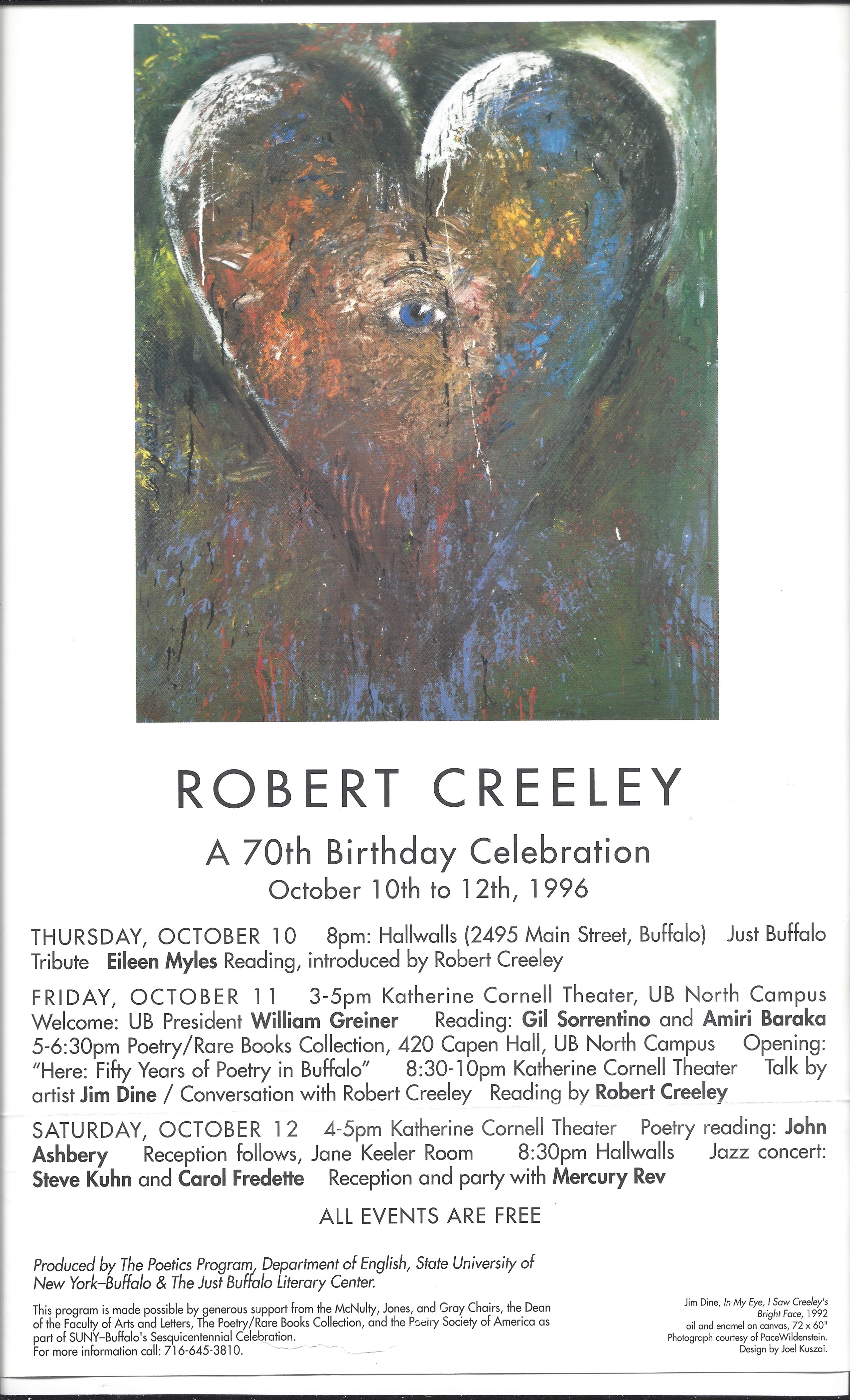
A tribute to Robert Creeley on his 70th birthday
Intro
I began secretly studying Japanese in junior high school, military phrase books and character dictionaries, only a couple of years after the war. During the war the woodblock prints and ink-painting scrolls were removed from the walls and I had a fascination with both enemies, playing those roles whenever we played guns and war. The other kids always praised me, “Blaisdell, you really know how to die!” My father, a naval officer, served in the Pacific and again during the Korean war, having his own squadron of destroyers–I loved calling them “tin cans.” He used to send me black, hard rubber models of enemy aircraft, the kind used by spotters for identification, three-dimensional versions of those silhouettes that filled the pages of treasured manuals, and also cast-metal model ships, the kind used in war rooms to plot sea battles. In miniature I had the Japanese fleet and a model of the Nagato, the low-slung battleship whose fate it would unforgettably be to surf up the gigantic stem of the atom bomb tested at Bikini.
My mother divorced my father after Korea. He had been at best intermittent during my childhood, disappearing immediately after Pearl Harbor; returning exhausted and raving only once during the war–they said it was “almost a complete nervous breakdown” (so I guess it was incomplete)–he would not recur in my life until we met when I was twenty-five, a graduate student making myself miserable by trying to find in positivism and mathematical logic something I might call “philosophy.”
As an undergraduate I studied Japanese formally. My hope by this time, unknown during the secret improvisations with phrase books and character dictionaries, always happy in the search there for radicals, was that one day I wanted to read Basho’s Oku no Hosomochi in the original. Dream on! Today, forty years past those upper and lower divisions, over thiry years in our beloved New Mexico–where even conversationally there is little chance of speaking the lingo–a stumblebum among romanji, the kanas and kanji, I still re-read Basho with love and with an always aroused memory of an ambition more youthful than each aboriginal, preasurable, reawakening.
What these flirtations with Japanese gave me, especially the more sophisticated formal one, was a lifelong passion for nikki, the Japanese poetic diary. In my ambition I saw it as a possible literary form, the condition of the prose demanding poetry, and vice-versa; the two in their mutual inspiration creating a third: neither prose nor poetry, and yet both; not something over and above, yet along side and out of, like love consummated, desire gratified, or Eve from Adam’s rib (she is our way of leaving him behind, naming his animals, while we explore the garden and discover the bad girl in ourselves—tempted, seduced and exalted—a real idea of education, in abandon).
2
Nikki: Daybook on Insistence
“The insistence was a part of a reconciliation”
–“The Operation,” from For Love
A couple of weeks ago I started thinking about your 70th birthday, 21 May 1926. That’s a lot of days, twenty-four thousand, nine hundred and twenty, to be exact, like they say. But what exactness is that? Life in days and numbers, the daily and material lost in numerical abstractions.
I know your idiom, can through ear call it to mind like having a poem by heart, line after line in the rhythm of time, unfolding.
But this was to be a gift, one given back for the one you are: it is divine to you to give. You bless. You speak of friends as being good news–yes, gospel, and you evangelical, and by announcing names you touch them. Friendship is not just hanging out, the way circumstances stand around their possibilities, guilty as every bystander, hands in turned-out pockets–this company hand in hand, loafing most invitingly while hearing the soul in the song.
Knowing the idiom, the lingo is always refreshed by yet another reading; in the mother tongue less chance of being a stumblebum though head over heels in love with the sound of it. I read For Love at a sitting on a hot afternoon. I began noting favorite words, phrases, diction, thinking to assemble them in a bouquet, like The Greek Anthology; but in no time I was writing down titles, acknowledging the unparaphrasable integrity of the poems, page after page, poem upon poem, my own selected bulking up. Would it be the same on another reading? I trust not: it would accumulate like a reef until all I had in hand was the book itself.
A note: insisted: to be of use / measured sense / puts hands and candles in / minds caressed and light / let it. What need of light when love guides hands.
Another note: wicker basket / woven, like a text, to fit what it contains / is never more than an extension of content. / Three of them brought wisdom over the highest mountains in the world: Tripitaka: one of discipline, the second of wisdom, and the third contained metaphysics. The baskets disappear beyond imagination and what remains? The poems they are / as they are.
3
Insistence is urgent, pressing, and it lasts, compelling attention. In the interview the other guy said he thought Lacy was a wonderful original. “I do too,” you said, “He’s tough. He stays put.”
There’s the idiomatic insistent rhythm that I hear repeatedly in Luther’s “Hier stehe ich, ich kann nichts anders.”
That Hardy older man of Echoes’ “First Rain,” momently Catullian in “Self Portrait,” finding the composure of “Stone” (Aquinas: “Stones point toward their homes”) and the winning abandon of “Echoes”: “Say yes to the wasted / empty places. The guesses / Were as good as any.”
Sometimes when I imagine our New Mexico I see the volcanic and flat horizon of the West Mesa, rearing eternally its arid tsunami above the Rio Grande, and as if a child dripped from its hand the sand to build its castle from the hard inshore, I see me say, “Creeley is Giacometti to this place.”
On my fiftieth birthday I was in Cambridge for a year. It chanced that it was also the 350th anniversary of the Blaisdells’ arrival in New England in Richard Mather’s company aboard the Angel Gabriel, tossed ashore over her masts and cracking like a nut on that rocky coast. Not a soul was lost, amazingly, and all those years later the Invitation to the anniversary bid us come and drink in water a toast to our common ancestor–could that really have been the syntax! For my birthday my girlfriend went to the Concord Cemetary, climbed the hill and took a snapshot of Thoreau’s headstone: HENRY is all its granitic slate said.
The locomotive dark still drives toward dawn. Henry said we had constructed an engine worthy of ourselves. He called it Atropos, a fate, one that doesn’t turn aside but keeps going. He said he would like to be a track repairer somewhere in the orbit of the earth.
I spent years asking friends, including you, who it was had said, “a tiny piece of steel, properly placed,” and you all said, “Lew Welch.” Nobody could find it. Eventually it turned up in one of Jonathan Williams’ quote books: it was yours. It had that hard Dickinsonian ring to it. I imagined the train un-derailed, running over the tiny piece of steel, shooting it off the rail, into a poet’s hand, leaving it sharp as a burin–and the poet keys the train, from the locomotive with its slashing Mars-light to the red-eyed disappearance of the caboose.
5/17: I was flipping through Echoes in search of a poem when my eye was caught by a poem inside that you’d inscribed but I had not previously seen: “Pure,” about how it can be an inspiration–indeed, a drawing in of breath–even when the toilet backs up through the bathtub drain while one is showering.
4
That night I crossed over the bridge of dreams, as the nikki say. My mother’s long black hair came out of the drain hole in the tub and lashed itself around my tattooed ankle. I was not terrified, and instead of waking from my nightmare stayed asleep, walked in sleep as I had as a child, down the hall, into the living room, and woke with a book in my hand. I knew where to look even while still dreaming: Basho’s Record of a Weather-Exposed Skeleton.
The great poet returns to his birthplace and is shocked at how everybody has aged. One of his brothers likens him to Urashima, whose hair turned white on opening a miracle box. The brother hands such a box to Basho. It contains his umbilical cord and a lock of his mother’s hair: “Should I hold it in my hand / It would melt in my burning tears / Autumnal frost.”
I know a man whose years of blessings I am honored to return on his birthday. I am so glad he is talking all the time, talking back the surrounding darkness, putting in the candles where they need to be, forgiving and lightening my own once cyclopean dark with his friendship and his poetry.
1996 / 2001 (?)
Undated and unpublished computer-file manuscript. While it was almost certainly composed in May 1996, on the occasion of Robert Creeley’s 70th birthday,this piece was probably revised in the fall of 2001 when Gus submitted it for consideration for possible inclusion in the UNM Press collection, In Company: an Anthology of New Mexico Poets after 1960. It was not used in the anthology, however. In correspondence Gus indicated that he considered this text to be a poem in prose.
Allan Graham, Moon 2, 1986, oil on canvas, 83 in.x 91in. Private Collection
Omoide No Tsukimi for Ronald Johnson 1935—1998
It rises to self-awareness
Horizon that is always with us
Black north’s direction
Risen from the belly nightsky
Phantom blot, inkblack Heian hair
Coiled black pythoness
On moonless nights
Monk sleeves trailed through wet grasses
It hangs eternal there, never sets or climbs
Fulgent Moon 2, lightning struck through
Lightning flash
Then back to black
What seams this darklight
But black holds back, insists
At backbehindness it sustains
Unreflecting primordial companion
All phases of the moon condense
Moon 2 takes breathing, animates itself
Without horizon other than itself, irregular oval of all moons
Even when full or crescent sickle thin slice on either end
Blindspot
At last Narcissus lies faceless
Bottom of unsounded pond
Face buried in a silken muck
Thankfully in reflection I am dark to myself
Tarbaby reflections of Moon 2
Glitters in the total void
Senses steep in unsounded dark
Where darkbather mind
And sunbather eyes intersect
The heart is black and madder
The soul is fishscale black
Thunder underneath the under
Heart and soul begin a fisted journey
To the behindblackness
At our backs we always feel
Always back there behind it all
From head to heel black chrysalis
Hangman’s hood or shiny bodybag.
–Gus Blaisdell
Moon2 is an all black painting by Allan Graham. My Japanese title means remembering moonviewing. The line beginning “Thunder . . . ”, set in italic, varies a line from a manuscript, “The Imaginary Menagerie,” by the visionary poet Ronald Johnson. [Gus’s endnote.]
Notes from a Bottle Found on the Beach at Carmel stands as an apparent hiatus in Evan Connell’s formal development. But the peculiar nature of the work is only partly structural–the mosaic technique carried a step further–and the themes it develops are consistent with the rest of Connell’s canon. The main interest of the work resides in the voice or tone of the narrator and in the formal assumptions necessary to this kind of writing, a form that appears essentially new.
A fragment of Notes, more provincial, lumpy, prosy, and less interesting, appeared in 1959 in Contact 3. Connell there remarked that he frankly did not know what the writing amounted to but that it had a curious fascination for him, like doing a complicated, private dance unobserved. Three years later, very much altered and enriched, the work appeared in full in Contact and was brought out the following year in a hardbound edition by Viking.
Kenneth Lamott, speaking for the editors when Contact devoted the December 1962 issue to Notes, characterized the writing: “It eludes the usual categories of literature, falling somewhere in the dimly defined but extraordinarily fertile area where prose and verse, fiction and nonfiction, metaphysics and science meet.” Connell himself has said of the work: “I think of it as a work of close association rather than free association;” on the form, “. . . ‘cohesion’ is as close to ’structure’ as I’d care to make it.” At the end of the editors’ introduction in Contact, writing in the style of the work itself, Connell declares his intention: “It is incumbent upon me to establish some / image whereby / all men must judge / future interpretations, believing / in the value of mine. This I do tenderly, / humbly / and with a knowledge of utter obligation.” For lack of a better term, such writing might be called “vatic.”*
Works of vatic literature are as unpopular as they are infrequent in contemporary American writing. It is only a bold or foolish writer who would undertake a work that is in direct opposition to the inherent skepticism of the American temper, that empirical or pragmatic attitude that judges all prophets false until proven valid, and then, at best, as highly dubious. Yet far more important than the climate opposed to such writing are the pitfalls within the medium itself, stumbling blocks that would seem to preclude success from the beginning.
In a sense, vatic writing, like art for art’s sake, is writing for the sake of writing. Its joys are the density of prose often archaic in syntax and diction; a delight in (and attention to) rhythm and the well-turned phrase; the precise perception; the terse tautness of apothegm and aphorism; the use of myth, esoteric lore, and bizarre fact; and the viable image. Already the writer has assumed a heavy mantle and runs many risks.
Should the fatidic tone fail, vatic writing results in rhetorical flatulence. The hyperbolic or elliptical style, together with the mythic lore, may prove elusive. If an image or myth fails to properly illuminate a part of the theme, the writing degenerates into inscrutability. In its attempt to partake of the best of prose and verse, vatic writing raises the question of how far the lyric impulse can be stretched. Or, more generally, as John Wisdom once wrote on the nature of early analytic philosophy: “It is not the stuff but the style that stupefies.” For a writer of Connell’s ability the mere stupefaction of style would be a disastrous result.
Unlike the novel or sonnet, vatic literature is not a literary form as much as it is a style or posture or stance. A prophetic or oracular voice is assumed together with a style appropriate to the fullest possible expression of that voice. Thus it can also suffer from over-richness. There are a number of interesting assumptions that must be made and met: these are the properties of the terrain as illustrated in Notes.
The medium of the writing is atemporal, allowing the narrator to range at will through time; the stage is epical. Another premise is that there are necessary, causal connections between past events and future ones; that the past, if it does not completely prefigure the future, is at least exemplary or emblematic of events to come. Unlike the Humean universe of discrete, noncausal particulars, the universe assumed here is well-ordered. The task set for the narrator is to illumine the teleology of the world. The point of view is sub specie aeternitate, assuming the unity of human nature and human purpose, and the position of the narrator is that of the mystic who, as Wittgenstein wrote, views “the world as a limited whole.” The world of Notes, similar to Wittgenstein’s world in the Tractatus, “waxes and wanes as a whole,” and the narrator records this. Atrocity and brutality are the dark of the moon; love and beauty, the full moon. There is, in Notes, an element of Yeats’ philosophy based upon the phases of the moon.
A crucial problem in this kind of writing, and one tied intimately to the atemporal structure, is the use of a disembodied voice, a narrator without individual, personal identity who changes masks at will; all the masks of time are available to him–he can be all men at all times, a particular man at a particular time–a device that results in the uneasy fact that he is nobody in particular. Space and time become points of recapitulation, coordinates for heraldic moments in the history of the human spirit.
Because individual characterization does not occur in vatic writing, there is little if any distance between author and reader, the only buffer being the elegance of the prose, the odd lore, and the incisiveness of the imagery. There is no possibility of suspending disbelief or of learning through the experiences of a character, as in a novel. Consequently, we are given the author’s truths without first having been seduced into sharing his doubts. The relationship between author and reader is litanical–prayer and response, incantation and reaction. Perhaps the greatest single risk here is that all the rich embroidery of a Penelope may issue in little more that a sampler to be hung on the wall; in this case, should Connell fail totally, instead of “God Bless Our Happy Home” we would be handed “God Damn Our Rotten World.”
If Connell’s Mrs. Bridge is characterized as a mosaic form, Notes, moving even further into the fragmentary, is kaleidoscopic. Connell seems to have had something like this in mind when the voyager of Notes writes: “The barrel turns, the crystals tumble.” This kaleidoscopic form poses an interesting metaphysical position in the book.
In a kaleidoscope a pair of plane mirrors provides the viewer with an illusion of symmetry. Each time the tube is turned, the pile of glass changes position and the symmetry reappears under a different guise. In terms of this metaphor, the reader’s task is to unearth the principle of order, thereby arriving at the crucial concerns of the work. Ideally, as in the toy, the symmetry should always be present. It is the cohesive constant.
Connell has further extended this notion to provide Notes with a cosmological model of reality. The world, like the chips in the kaleidoscope, can only be seen as ordered in a particular way. Unlike the toy, however, in the real world man can never get through the illusionary order to that hypostatized world beyond, which W.V.O. Quine has called “a fancifully fanciless medium of unvarnished news.” Connell in Notes asks us to remove our conventional spectacles, to break down the barriers and masks of our vision, and to return from our lethargic atavism with new eyes. If Notes is to be successful, something like an epiphany must take place.
The voice of the Voyager-Narrator is basically that of Magus–magician, seer, alchemist, sailor, conquistador, warrior, victim, poet, church father, anchorite, heresiarch, philosopher, executioner, and scientist. The major theme of the voyage is to be found in the recurrence of alchemical imagery. The voyager’s quest is to discover within the soul of man a formula that will transform the gross spirit into something precious. The soul is bipolar, bifurcated, Gnostic and Manichean in Connell’s world, and he continually juxtaposes prayer and creativity with brutality, as in the opening sections where he quotes in Latin the Lord’s Prayer, then delineates the butchering of a saint. The beauties of nature are opposed to the atrocities of Hiroshima and the Nazi extermination camps. Animals throughout become insignias of the beasts with the spirit of man, sometimes beautiful in their symbolic expression of human longing; at others, hideous in their viciousness. During the voyage, prehistoric monsters are found still living off the shores or Madagascar and Australia and these merge with the man-made mutants of Japan and Bikini Atoll. Astronomical theories of the destruction of the solar system are paralleled with thermonuclear annihilation; the ritual of execution, particularly the ghastly ceremonialism of gas chamber and electric chair, coincides with the deus ex machina morality of Dachau and Belsen.
“Perhaps it is true, / we are like those doves that stand / between cathedral bells / until they have lost all sense of hearing,” notes the voyager, a man who has despaired of Western tradition because of the crimes perpetuated in its name–“We live in the final tepid rays of Christianity”–and who has turned to the Black Arts, Finnish magic, shamanism, and lycanthropy. “Mankind yearns for annihilation. / The earth shall revert to worms and the rolling sea / to plankton.” Reflecting on the great New World civilizations of the Maya, Inca, and Aztec, the voyager expresses his fear of a world reduced to dolmens and stelae. “One heart, one way,” he admonishes: “Pass by that which you cannot love.”
Man’s fall, like that of the Wandering Jew, is into consciousness–to suffer in anticipation, actuality, and recollection. “Natural things look upon us / and our wonders with repugnance.” The voyager asks, “What is the color of wisdom?” and announces that it must have the color of snow.
In Connell’s view, man is caught halfway between the beast and the angel, both locked in moral combat for the possession of the soul of which they are essential complements. We may take the beast to our graves, but during our lifetimes it is capable of atrocities outstripping the imagination. The plea of the voyager asks of our humanity that it be gentle and tender, that it relinquish the ways of terror and look lovingly upon the wonders of the world. The anguish of the voice is familiar in Connell’s fiction: it is Damaso, the fisherman from Chihuahua, at the height of his song; the voice of the young Augustine in the throes of doubt and longing. Magus himself, “poised between the dream and the act,” informs us that “credulity is greatest in times of calamity,” and that the millennium shall arrive when mankind has become unbelievably atrocious.
Taking a point from an entry in Wittgenstein’s Notebooks–“To pray is to think on the meaning of life.”–Connell’s Notes may best be regarded as a psalter for post-thermonuclear man, the palimpsest of hibakusha.**
Notes:
*Oracular or prophetic, from the Latin vates, meaning seer or prophet. A footnote in the original text reads: “I owe a great debt for the sharpening of my ideas on vatic writing to correspondence with Luis Harss.” [Gus’s original footnote.]
**The Japanese term hibakusha means “those who experienced the bomb” and refers to a psychological disease akin to post-traumatic stress syndrome, which occurred among the survivors at Hiroshima and Nagasaki. (Gus’s original text footnote credits Robert J. Lifton, “Psychological Effects of the Atomic Bomb in Hiroshima,” Daedelus, Summer, 1963.) A theme woven throughout the “After Ground Zero” essay is how Cold War anxieties can be seen as a backdrop to Connell’s writing in general. However, Gus writes, “The fear of thermonuclear destruction does not obsess Connell. But what does anger him is the way in which the unimaginable power of today’s weapons has reduced man to a cipher.” Among the works discussed in “After Ground Zero,” only Notes from a Bottle . . . utilizes the stylistically experimental “vatic” approach. [Editor’s note.]
1966
Excerpt from “After Ground Zero: The Writings of Evan Connell, Jr.” in New Mexico Quarterly, Summer 1966.
The visionary poet Ronald Johnson reading from his manuscript “The Imaginary Menagerie” reached a short passage so arresting in its lapidary compression that it deserves to be cut in stone:
who once have sung
snug in the oblong
oblivion
Inscriptions are meant to pull you up short. “Stop, Traveler” is the most common beginning on the inscribed gravestones that bordered ancient Roman highways. Inscriptions in this elegiac genre give speech back to the dead. In Basil Bunting’s poem Briggflatts, a stonemason extols his craft:
Words!
Pens are too light.
Take a chisel to write.
Words, however weighty, bear a curiously unstable relation to stone. In Notre Dame de Paris Victor Hugo has Claude Frollo point at a book as he gestures from his cell window toward the sphinx-like shape of Notre Dame cathedral and utters the phrase: ceci tuera celá: This will kill that.
The chapter that follows this moment is called “Ceci tuera celá” and details the great dialectic of books undoing the Church, a story of freedom increasing through dissemination of the press, of a journey from dark to light, of the spreading literacy producing enlightenment, the testament of stone replaced by the testaments of the printing press.
Hugo’s main source about the history of architecture was the young Neo-Grec architect Henri Labrouste. Later, as if inspired to counter Hugo’s and Frollo’s prophecy, Labrouste built the Bibliothèque Ste-Geneviève. Free at last of the long-standing French obsession with the classical architectural orders, it is a library that reads like a book. Neil Levine, in a magisterial essay on Ste-Geneviève, Labrouste, and Hugo, reads the architectural details in an extended metaphor not only of the book but of the whole process of printing from movable type–from the names on the façade (which may be seen as type locked into chases) to the books of these authors that sit on the shelves directly behind the places where their names appear on the wall. Labrouste built a book of iron and stone that was functional and free, a building dedicated to contemplation and reading, absorption and study. It became a secular version of Hugo’s description of the Temple of Solomon. “It was not merely the binding of it, it was the sacred book itself. From each of its concentric ring-walls, the priests could read the word translated and made manifest to the eye, and could thus follow its transformations from sanctuary to sanctuary until, in its ultimate tabernacle, they could grasp in its most concrete yet still architectural form: the ark. Thus the word was enclosed in the building, but its image was on the envelope like the human figure on the coffin of a mummy.” Labrouste made his library perfectly reflexive and transparent, no difference between the inside and outside.
Hugo set his novel in 1482. Sixty-one years earlier, 12 March 1421, a congregation of Jews burned themselves alive in a synagogue on Judenplatz in Vienna rather than renounce their faith or be murdered by Christians. A plaque in Latin from 1497 commemorates the immolation by referring to the Jews as dogs or curs. Mozart wrote Cosi fan tutte in house 244 overlooking Judenplatz in 1783. On 12 March 1938, Nazi troops entered Vienna, 517 years to the day that the Jews burned themselves. Rachel Whiteread, a young British sculptor, unveiled her remarkable Holocaust memorial on Judenplatz on 25 October 2000, much delayed by politics from its originally scheduled completion date of 9 November 1996, the fifty-eighth anniversary of Kristallnacht.
Before the memorial could be built excavations began on Judenplatz to unearth the original synagogue. The first area dug down to was the bimah, the area where the ark is kept and the desk from which the Torah is read. Whiteread’s memorial measures 12′ x 24′ x 33′ and is a library turned inside out: the spines of the books face into the building. It is a cast made in white cement of the library’s interior. The doors, without hinges or handles, cannot be opened. The library cannot be entered because the imaginary interior, far from being empty, is solid: the presence of absence. “Casting the internal–If Rachel could drink a couple of quarts of plaster or pour resin down her throat, wait until it sets and then peel herself away, I feel she would. She shows us the unseen, the inside out, the parts that go unrecognized,” observed A. M. Homes.
John Baldessari, the California conceptual artist, still has nine and a half boxes of the ashes of his paintings. In 1969, when he realized that he would stop painting, he found a crematorium that would burn his paintings. His motive was to complete the cycle of the chemicals that made up his oil paints by returning them to earth. The original installation at the Jewish Museum in New York was to be an urn containing some of the ashes placed in one wall with a plaque beside it. A major funder of the show said she would withdraw funding if this was done. So Baldessari placed the urn on a pedestal. The urn he chose among the many on offer was in the shape of a book. This was the beginning of conceptual art, the ashes of paintings interred in an urn shaped like a book.
Horace (Odes 3.30.1) claimed he had written poems more enduring (perennior) than bronze and outlasting the pyramids. In “Lector Aere Perennior”–the reader more enduring than bronze–J. V. Cunningham disagrees with Horace. Every poet depends not just on paper or stone or bronze but on readers for his relative immortality. Yet the reader is a problem. What must the reader do if the poet is to have lasting fame? For Cunningham the reader must be:
Some man so deftly mad
His metamorphosed shade,
Leaving the flesh it had,
Breathes on the words they made.
The reader dies (the orgasmic “little death” of the text) that the poet may live again. Transported by the words of the poet, the reader transmigrates his soul and “breathes on the words they make.” His and mine become ours, a more amazing dialectic than turning the book of stone into the book of print.
An epigram by Plato had been a favorite of mine long before Ronald Johnson read to me from his inscription-like “Imaginary Menagerie.” Plato writes that it is said by Socrates to Agathon:
Kissing Agathon, I found
My soul at my lips.
Poor thing!
–It went there, hoping
To slip across.
It is one of the epigrams from The Greek Anthology. Is it somewhere carved in stone? Did each passing Greek read it aloud? Were the lines alternately painted black and red? As the Greek read the epigram aloud his soul too was at his lips, trying to slip across. From his lips to the stone, in a direction opposite that of Socrates whose lips were meeting those welcoming closed lips of Agathon. It is the soul that remembers and speaks in the poem, from within Socrates’ silence.
But though the soul rises to slip across it is a poor thing because it falls back–desire wants to slip across, believes in its heart that metempsychosis is possible, in its delusion a poor thing. This is the giving soul, the one that acknowledges and welcomes the other, not the Freudian narcissists whose lips kiss only images of themselves. And this happens every time we read.
When we read we slip across; we do not fall back. The words they made are like the love we had: the poem read through is like the exhausted beloved, over there, on the other side where we just were. The reader succeeds precisely where Orpheus fails Eurydice. We look back fondly. We behold the lineaments of gratified desire, what men and women in each other do require.
Chris Marker’s film La Jetée (The Jetty, France, 1962) runs 28 minutes and is constructed entirely of stills, except for a single moment of movement.
A brief synopsis of La Jetée will put the complexity of this moment in perspective. The Third World War has taken place; the earth is radioactive, uninhabitable; the victors rule underground over a kingdom of rats; concentration camps flourish one again. The story is of a veteran who survived the war and who carries within him a single image of peacetime: a woman’s face he had seen as a child on the jetty at Orly Airport. Because his imagery is so vivid the camp commandants subject him to experiments: he is injected, travels to the past and eventually to the future. He finds the woman he saw as a child; they fall in love. The moment of movement occurs after they consummate their love.
The woman opens her eyes and blinks three times, looking directly out of the screen. She wakes to look at her lover looking at her. He is not seen by us, but his presence is established by a series of overlapping dissolves in which the sleeping woman changes positions as she sleeps and he watches. The sound over these shots is of bird cries reaching a crescendo–so intense the cries sound like squeals of pain, a mysterious jouissance. (Could this be a Blakean moment? “How do you know but ev’ry Bird that cuts the airy way / Is an immense world of delight, clos’d by your senses five?”)
One of the abiding mysteries of film is that it is a medium of visible absence. In a notebook poem William Blake asked and answered several specific questions, among them the following:
What is it men do in women require?
The lineaments of Gratified Desire.
What is it women do in men require?
The lineaments of Gratified Desire.
To my knowledge, even using what he called his “infernal methods,” Blake never engraved these lapidary lines.
What happens when we read a story, a poem, a book, a building? Are we deftly mad enough to slip over? We love what looks back at us, studying to know everything, knowing the knowledge of love is inexhaustible, and knowing also that such work of the imagination is beyond the reach of even our best words. After having slipped across we return to ourselves, our experience enriched. The reader is like Jacob, blessed by the angel he wrestled. Touched on the thigh before he was released, Jacob was left with a limp. The angel touches us before we are released. If there is a new limp once we return from our struggle, our abandon, our transport, it is the happy fault–the felix culpa–that touches another soul, and both are the better for it. The poet gains his brief immortality; and we return to our mortality exhausted and renewed. Within those moments of movement while we read, and remembering what we read, acknowledging the autonomy and mystery of it, we briefly become the kind of person Henry James wished us to become: one on whom nothing is lost.
2003
Published 2012 in Gus Blaisdell Collected. This essay was originally intended for Inscriptions, a deluxe-edition book that was produced by Jack W. Stauffacher in 2003 to commemorate the lapidary inscriptions on the Old Public Library of San Francisco on the occasion of the building’s conversion into a new museum of Asian art. In the end, however, the essay was not used.
Dear Geoff, Just returned from Paris to find your ‘O Hermie, O Augie’ (an edited collection of letters between Geoff and Gus) waiting for me. I’ve never properly mourned Gus because I’ve never really believed that he is dead. I’m perfectly prepared to accept the Death of God, even the Death of Art, but the Death of Gus is inconceivable. Hearing his voice–loud and clear–in ‘O Hermie’ reconfirms my belief that Gus is immortal and eternal.
Below find an excerpt of Bldgs by Gus Blaisdell, his first essay on Lewis Baltz. Originally published in Three Photographic Visions, 1977. Republished in Gus Blaisdell Collected, University of New Mexico Press 2012.
______________________________________________
Bldgs
I regret that I must begin in a quandary. But since I am in it and have been in it ever since I first began trying to think and write about Lewis Baltz’s photography over two years ago, this quandary is not only the place from which I must begin but it may also be the place in which, entangled, embroiled, and exasperated once again, I am forced to conclude.
Allow me to elaborate in a figure so that I may come to the various questions which will clearly indicate the ranges of my confusing (but not inchoate) concerns.
In the room in which I am presently writing this essay everything is concrete. That simple italicized phrase struck me the other morning with all the philosophical force of a secular revelation. And it persisted throughout the whole day, nagged during the conscious moments of a fitful night, and was still hauntingly present this morning when, in a mood of exasperation bordering on despondency, I once again sat down to yet another revision of my seemingly endless, as yet unfinished essay on the work of Lewis Baltz–my project a pile of notebooks, pages, file cards, jots and scribblings that has been with me nearly every day since that day in 1975 when I unexpectedly received in the mail a complimentary copy of The New Industrial Parks Near Irvine, California. As I leafed through the book it steadily dawned on me that Baltz was doing something in photography specifically and in art generally that had not been done before in either domain. His work stood forth as a summary limit and an extension, a point at which the promise in the work of others was engendered and fulfilled, and a point beyond which nobody else had gone. So strong was this conviction that it expressed itself paradoxically, that Lewis Baltz was a painter who had chosen photography instead of paint in which to make significant objects. The paradox here is not in the apparent restrictions consequent upon such a choice but in the media Baltz would be crossing and in the successful translations he would have to achieve. A painter who used photography–there was something of Japanese aesthetics in that, and in the restriction of means and the accepting of the automatisms that constitute photography, further limiting this medium to work in black and white fixed images.
Again, the above also had the philosophical force of worldly revelation and it has persisted, often annoyingly, throughout the years that have lead to the present writing in this room in which everything is concrete. Nothing here is abstract unless it is my mind or the meanings my written words may carry as my sentences achieve equilibrium. Everything in this room except mind and meaning is photographable, will yield an individuated aspect that can be fixed upon film. (The difficult “things in this room” that are not obviously individual and thus fixable are light, dark, and the shadows cast by the interruption of light by objects. None of these seem either trivially concrete or plainly abstract. Penumbral seems to be the accurate term here. And the penumbral is difficult for photography not only as object matter–what the camera points at out there–but also as subject matter, what gets fixed in the frame and shown in the print; and what takes its further meanings, beyond the frame and outside the print, from whatever network of knowledge happens to contain the print centrally and essentially like an idiom or a poem.)
The only conceivable thing in this room which might be wholly abstract in relation to every other photographable thing is a photograph by Lewis Baltz, Maryland 24, a photograph which is endlessly a reminder of this quandary in which I daily encounter my thought…







 blaisdell Ivey collected